

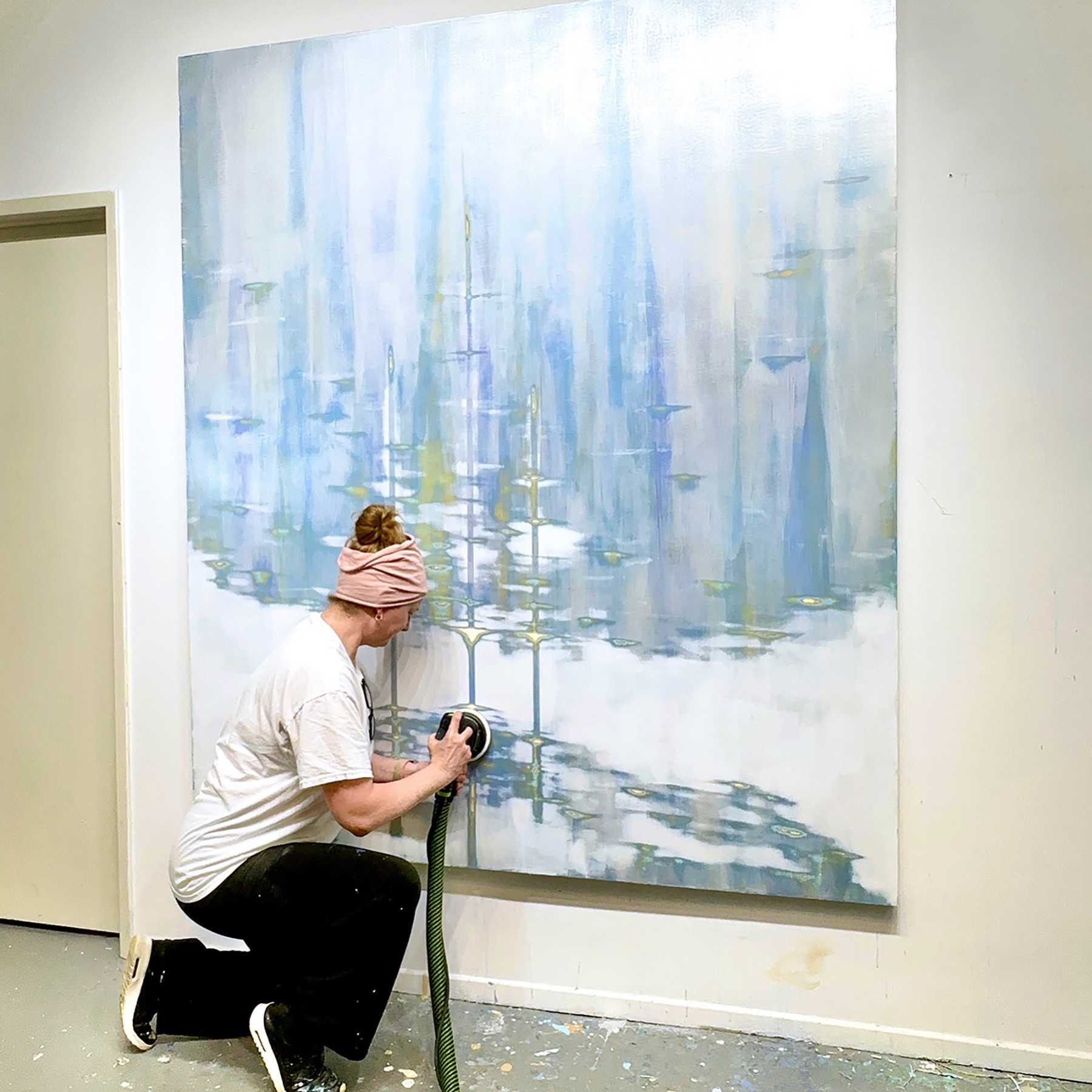
A sander, not a brush, makes the final mark in an Audra Weaser painting.
That single fact separates her from most artists working in the "abstract landscape" category, a label that gets applied loosely and usually means very little. It means something specific here. Weaser builds a painting the way a printmaker builds a plate: additively first, then destructively. Color goes down in layers on a wood panel. White paint follows, covering nearly all of it. Then she sands. What survives that process, and what doesn't, is the composition.
Who Is Audra Weaser?
Weaser was raised in Southern California and lives and works in Los Angeles. She earned her M.F.A. in painting from Claremont Graduate University, where her earliest work took the form of sanded wall sculptures rather than paintings. That detail matters more than it looks like it should. The subtractive, physical logic of those sculptures carried directly into the paintings she's known for now.
For the past decade, her focus has been nature, specifically the transitions she remembers from growing up between mountains, ocean, and desert. Not a single landscape. The seam between landscapes.
Her work sits in private and public collections in New York, San Francisco, Hong Kong, Abu Dhabi, and Singapore. Represented by Laura Rathe Fine Art in Houston, Dallas, and Austin. JoAnne Artman Gallery in Laguna Beach. K Imperial Fine Art in San Francisco. Samuel Owen Gallery in Greenwich and Nantucket. Lanoue Gallery in Boston. Julie Nester Gallery in Park City. Merritt Gallery across Baltimore, Chevy Chase, and Haverford.
The Excavation Technique: How Sanding Finishes the Work
Here's the process, in order.
Weaser applies layers of color to a wood panel, working toward a loose, intuitive composition. She then covers that composition with an overlay of white paint, obscuring nearly everything she just built. The final stage is the one she calls excavation: sanding back through the white and into the color beneath it, physically, by hand, until an image of motion and depth surfaces from underneath.
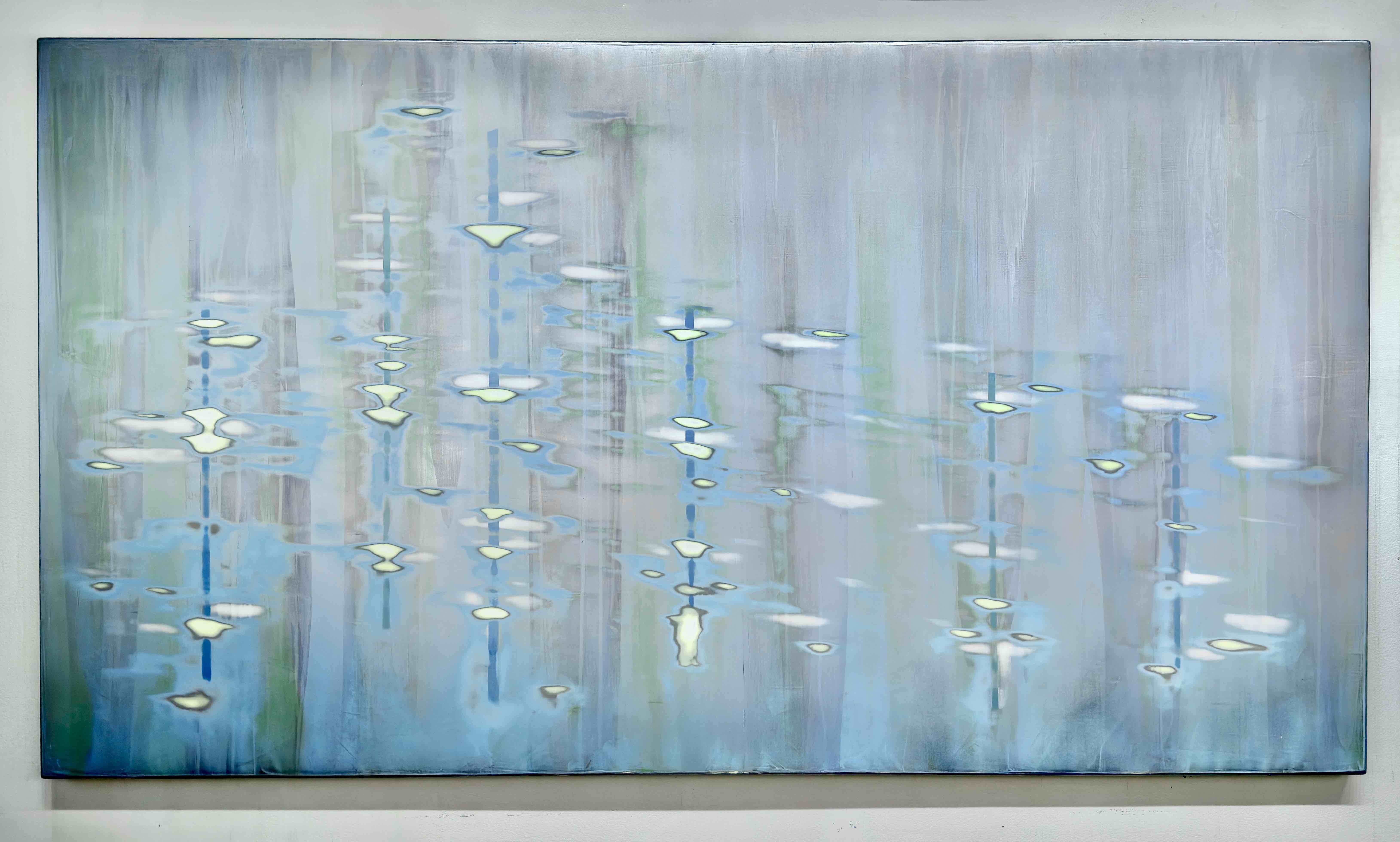
She's described the effect in her own words: "The trees reflecting on a watery plain reveal a shimmering version rather than a solid fact. My paintings are a desire to . . . reconnect to the unseen as a resonating poetic experience."
That's not incidental phrasing. It's the whole argument for why the work looks the way it does. A brush stroke describes a thing. Sanding reveals one. The difference shows up in how the paintings read from across a room: not as a rendering of a forest or a bayou, but as the flicker you catch out of the corner of your eye when light hits moving water. Weaser isn't painting the reflection. She's painting the unreliability of it.
Southern California as Source Material
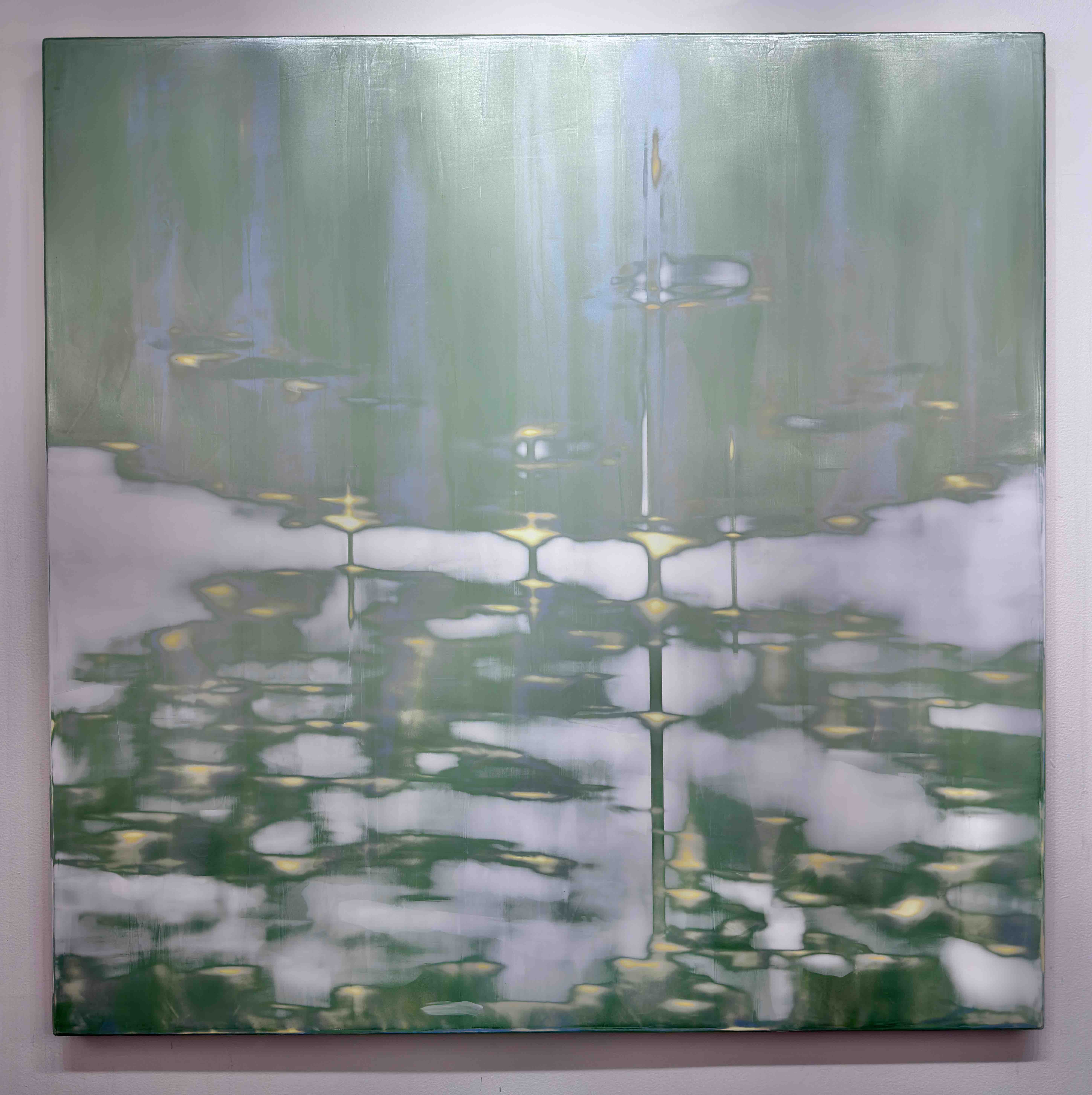
Ask where the imagery comes from and the answer isn't a specific place. It's a transition. Weaser has pointed to her memories of the terrain shifting between mountains, ocean, and desert growing up in Southern California, the kind of landscape that changes character every twenty miles. That instability shows up formally in the work: swampy bayous, mystical forests, light breaking through gathering weather. None of it is topographical. All of it is atmospheric.
Audra Weaser in Context
Weaser's process borrows from a few distinct traditions without belonging fully to any of them. The additive-then-subtractive method has roots in process art, where the record of the artist's physical action becomes part of the content. The restrained, atmospheric palette and the interest in light-as-subject owes something to color field painting. And the insistence on landscape, however abstracted, as raw material connects her to land art's core premise: that nature itself, not a representation of it, is the medium worth working from.
She doesn't sit neatly in any of those categories. That's generally true of the artists worth paying attention to.
FAQ
What is Audra Weaser's painting technique called? She calls it "excavation." It involves building layers of color on a wood panel, covering them with white paint, then sanding back through the surface to reveal the composition underneath.
What is Audra Weaser's work about? Her paintings for the past decade have focused on nature, particularly the way light and reflection behave on water. She's drawn to imagery like forest reflections, bayous, and light breaking through weather, filtered through memories of Southern California's shifting terrain.
Why do interior designers use large-scale abstract landscape paintings like hers? Large-scale abstraction offers visual presence and depth without competing with a room's palette or requiring a narrative reading. Weaser's sanded surfaces respond to changing light throughout the day, which adds a dynamic quality that flat, printed, or purely decorative pieces don't offer.
Did Audra Weaser start out as a painter? No. Her earliest work was sanded wall sculpture, made while she was studying abstract, non-objective painting at Claremont Graduate University. The subtractive process from that sculptural work became the foundation for the paintings she's known for now.
The Takeaway
Strip away the material specifics, the wood panel, the white overlay, the sander, and Weaser's project is simple to state and hard to execute: make a landscape that behaves like a memory instead of a photograph. Shimmering. Partial. Gone if you look at it too directly.
A sander, not a brush, gets her there.
If you're building a collection or a room around work that operates this way, on light, on reflection, on the physical trace of process, Carousel Fine Art can help you find artists working in that same register. Explore our current roster or reach out directly to talk through a specific space.
