

A woman's hand reaches into a Mondrian and pulls. A strip of white unrolls straight down through the red square, past the black lines, into the blue. In Caroline Dechamby's Hold On (Mondrian), the most orderly grid in modern painting is coming loose, and the person loosening it is the artist herself.
What is "art about art"?
Art about art is any work that takes another artwork as its subject. It can copy a painting, quote it, parody it, repeat it, or step inside it. The term covers everything from a student sketching in a museum to a Supreme Court case.
For most of history, it wasn't controversial at all. Painters learned by copying. Copying the masters was how you joined them. So how did a copy become a provocation?
1919: a mustache on the Mona Lisa
In 1919, Marcel Duchamp bought a cheap postcard of Leonardo's Mona Lisa, drew a mustache and goatee on her in pencil, and titled it L.H.O.O.Q. Read aloud in French, the letters make a crude joke about her.
It took him a few minutes. It changed the question. Duchamp wasn't learning from the masterpiece. He was arguing with it, and with everyone who treated it as untouchable.
The 1960s: Pop takes the masterpiece, and the brushstroke
Forty years later, the argument went mainstream. In 1963, Andy Warhol silkscreened the Mona Lisa thirty times in one canvas. Between 1965 and 1966, Roy Lichtenstein painted his Brushstrokes series, turning the loaded, personal gesture of Abstract Expressionism into a flat cartoon of itself. That same year, Yves Saint Laurent sent Mondrian's grid down the runway as a dress.
The masterpiece was now raw material. But was anyone allowed to take it whole?
The backlash: Sturtevant
In 1964, the American artist Sturtevant began making near-exact repetitions of work by her own contemporaries: Jasper Johns's flags, Frank Stella's stripes, Andy Warhol's Flowers. Warhol was so taken with the idea that he gave her one of his original Flowers silkscreens.
Most of the art world was not. Critics and some artists were openly hostile, and in 1974 she stopped exhibiting for more than a decade. She came back in New York in 1985, into a world that had caught up. By then, Sherrie Levine had rephotographed Walker Evans's Depression-era pictures and shown them as her own, under the title After Walker Evans (1981). Appropriation had a name.
Sturtevant won the Golden Lion for Lifetime Achievement at the Venice Biennale in 2011. In 2014, the year she died, the Museum of Modern Art opened Sturtevant: Double Trouble, her first comprehensive survey in the United States.
The argument never fully settled. On May 18, 2023, the U.S. Supreme Court ruled 7 to 2 against the Andy Warhol Foundation over its 2016 licensing of Orange Prince, a Warhol portrait based on Lynn Goldsmith's 1981 photograph of Prince. The ruling was narrow, covering that one license, but it reminded everyone that borrowing has limits.
Who was left out of the conversation?
For all that arguing, the masterpieces being argued over were almost all by men. In 1989, the Guerrilla Girls counted the modern art galleries of the Metropolitan Museum of Art. Less than 5% of the artists were women. 85% of the nudes were female.
Women were in the paintings. They just weren't the ones holding the brush. Later recounts, in 2005 and 2012, found little had changed.
That is where the conversation has gone next.
Caroline Dechamby: stepping inside the masterpiece
Dechamby is a Dutch artist, based in Switzerland, with a career of more than three decades. Her method answers the Guerrilla Girls directly. She paints the composition of a modern master in oil on canvas, mounts a sheet of plexiglass over it, and paints herself onto the plexiglass, inside the picture. Sometimes she appears full-figure. Sometimes only as a silhouette. Duchamp and Sturtevant are the artists who opened the door for her.
Duchamp drew on someone else's masterpiece. Dechamby paints herself into it.
She brings three works to Art Miami 2026. In Hold On (Mondrian) (2026), her hand pulls a long strip down through Mondrian's grid. In Rothko's Brush (2024), a woman in a white dress stands at work on a field of yellow and blue, the painter rather than the subject. Orange Dot (2026) has her reaching into a scatter of stars, dots and small creatures. Over the years she has stepped into Picasso, Matisse, Basquiat, Botero, Alex Katz and Banksy the same way.
 |
 |
|
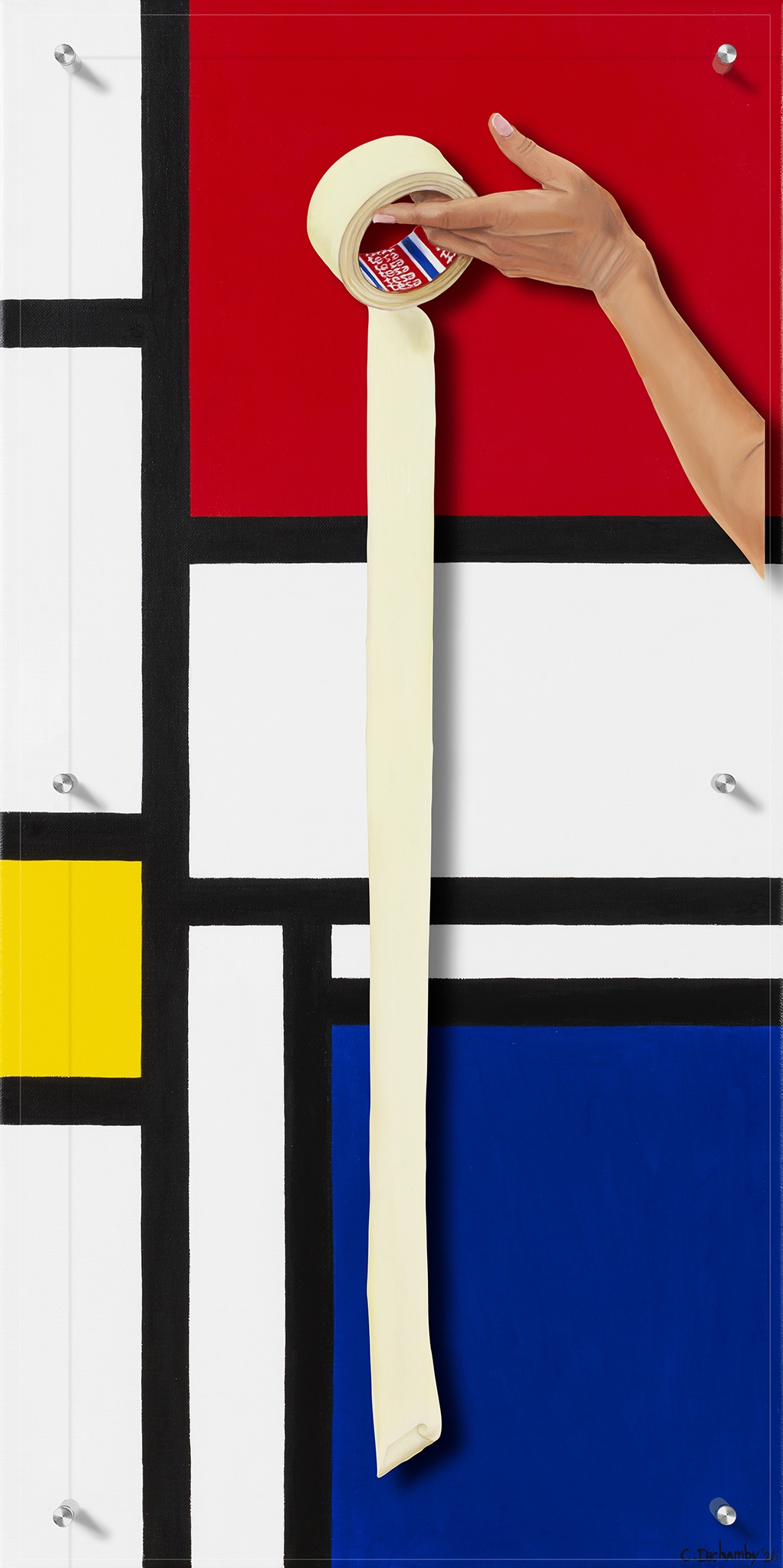
The question in every one is the same one Sturtevant asked, turned around: whose painting is it now? See Caroline Dechamby's work.
Taher Jaoui: inheriting without quoting
There is another way to talk back to the masters, and it doesn't quote a single painting.
On November 8, 1948, six artists and poets met at the Café Notre-Dame in Paris and founded CoBrA, named for their home cities: Copenhagen, Brussels and Amsterdam. Asger Jorn, Karel Appel, Constant and Corneille wanted painting to start over, raw and fast, closer to a child's drawing than to a museum. The group broke up in 1951. Its way of painting didn't.
Taher Jaoui paints like someone who inherited that argument. He was born in Tunis, trained as a financial engineer, and studied and worked as an actor in Paris and Los Angeles before teaching himself to paint. He works on raw canvas in oil, acrylic and charcoal, turning it as he goes. His influences run from post-war Abstract Expressionism and CoBrA to African art, graffiti and glitch. Look closely and the marks include equations.
His eight canvases at Art Miami 2026, all from 2026, carry titles like Between Two Choices, Exit the Loop and Temporary Reality. Nobody's composition is borrowed, and nobody steps into the frame. The conversation with the masters is still there, in the speed of the line. See Taher Jaoui's work.
See them at Art Miami 2026
Both artists are in the Carousel Fine Art booth at Art Miami, December 1 to 6 at One Herald Plaza, alongside seven others. The full list is in our Art Miami 2026 booth guide.
Back in Hold On (Mondrian), the strip is still unrolling. It isn't clear whether she is taking the painting apart or holding it together.
Frequently Asked Questions About Art About Art
What is appropriation art? Appropriation art borrows existing images or objects, often whole, and presents them in a new context to change their meaning. Marcel Duchamp, Andy Warhol, Sturtevant and Sherrie Levine are among its best-known artists.
What did Duchamp's L.H.O.O.Q. mean? In 1919, Duchamp drew a mustache and goatee on a postcard of the Mona Lisa. The title, read aloud in French, is a crude pun. The work mocked the reverence around famous masterpieces.
Who was Sturtevant? An American artist (1924 to 2014) who, from 1964, made repetitions of works by contemporaries like Warhol, Johns and Stella. Hostile reactions led her to stop exhibiting from 1974 until 1985. MoMA gave her a full U.S. survey in 2014.
Is it legal to make art based on another artwork? It depends on how much is used and how the new work is used. In 2023, the U.S. Supreme Court ruled that one commercial license of Warhol's Orange Prince was not fair use. Works in the public domain are free to use. This is general information, not legal advice.
What is CoBrA? A European avant-garde group founded in Paris on November 8, 1948, by artists from Copenhagen, Brussels and Amsterdam. It favored raw, spontaneous painting and dissolved in 1951.
Which contemporary artists reference art history? Caroline Dechamby paints herself into works by Mondrian, Rothko, Picasso and others. Taher Jaoui's abstractions draw on Abstract Expressionism and CoBrA. Both show with Carousel Fine Art.

