

Yayoi Kusama passed away thirteen days before anyone outside her studio knew it.
She died on August 14, 2026, in a Tokyo hospital, at 97. Her foundation didn't say a word until August 27. When the statement finally came, it didn't lead with cause of death or funeral arrangements. It said she "continued to paint until her final days, never setting aside her brush."
That was the whole announcement, more or less. A woman who had spent seven decades making some of the most photographed, most Instagrammed, most publicly adored art on the planet chose, one last time, to disappear first and explain later.
She had a word for that instinct. She called it self-obliteration.
The Girl Who Saw the Flowers Talk
Kusama was ten years old, growing up on her family's seed nursery in Matsumoto, when the hallucinations started. Flowers spoke to her. Patterns on the fabric in front of her multiplied, spread, and swallowed the room. She drew what she saw because there was nowhere else to put it. Her mother, who ran the household with a temper Kusama would later describe plainly and without softening it, confiscated the art supplies. It didn't stop her. Almost nothing would.
At thirteen, she was pulled out of ordinary life to sew parachutes for a wartime factory. She called those years "closed darkness." At twenty-seven, having decided Japan was, in her words, too small, too servile, too feudalistic, and too scornful of women to hold her, she wrote to Georgia O'Keeffe out of nowhere, asking for advice about breaking into the New York art world.
O'Keeffe wrote back. Kusama left for Seattle, then New York, in 1958, with almost nothing and no plan for what would happen if it didn't work.
New York Noticed, Then Forgot to Give Her Credit
It worked, for a while, on her own terms and often against the room's. Her white net paintings, vast fields of a single obsessive gesture repeated until it stopped reading as gesture and started reading as weather, got her a show at the Brata Gallery in 1959. Donald Judd bought one. S
he spent the 1960s deep in New York's avant-garde, covering furniture in soft phallic protrusions before anyone called that a movement, organizing nude polka-dot "happenings" in Central Park and on the Brooklyn Bridge as protests against the Vietnam War, dressing in a gold kimono at the 1966 Venice Biennale to sell mirrored spheres off the lawn for two dollars each until the organizers made her stop.
She was also, repeatedly, overlooked in favor of the men standing next to her. When Kusama showed a room lined with photographs of her own installation, and Andy Warhol showed wallpapered cow photographs not long after, it was Warhol's version that got remembered as innovation. Art historians have since pointed to something plainer than coincidence: a combination, as one put it, of sexism and racism that kept a Japanese woman from getting the credit her white male peers received for ideas that ran parallel to, or came after, her own. It wore on her. She attempted suicide more than once during those years, worn down by money she didn't have and recognition she couldn't seem to hold onto.
Choosing the Hospital
In 1973, she went home to Japan, and Japan did not welcome her back warmly. Depressed and unable to work, she attempted suicide again. In 1977, she found a psychiatrist who treated her through art rather than around it, and she checked into Seiwa Hospital in Tokyo. She never checked out. For the next forty-nine years, by her own choice, she lived inside a psychiatric institution, walking each day to a studio across the street where she painted, for hours, often alone.
"If it were not for art," she said, "I would have killed myself a long time ago."
This is the part of her story that's easy to sentimentalize and important not to. Kusama lived with obsessive-compulsive disorder and hallucinations for her entire life. The dots were never a style she chose the way a painter chooses a palette. They were how the inside of her mind actually looked, rendered outward until there was more pattern than room left to hold it, a process she named herself: self-obliteration, the self dissolving into the field until the field is all that's left. It wasn't a metaphor for her. It was a description.
The World Finally Caught Up
It took decades, but the rest of the art world eventually arrived at the same conclusion Judd had reached in 1959. Retrospectives in the late 1980s and 1990s brought her back into view. Her 1993 return to the Venice Biennale, a mirrored room crowded with polka-dotted pumpkins, is now considered one of the defining installations of her career.
By 2017, when the Hirshhorn Museum opened a fifty-year retrospective built around her Infinity Mirror Rooms, people lined up around the block for a ninety-second turn inside a room made of light and reflection. The show generated 34,000 Instagram posts to the Smithsonian's own channels in a single day. An artist who had spent the 1960s losing credit to men copying her ideas had, by her late eighties, become one of the most photographed artists alive.
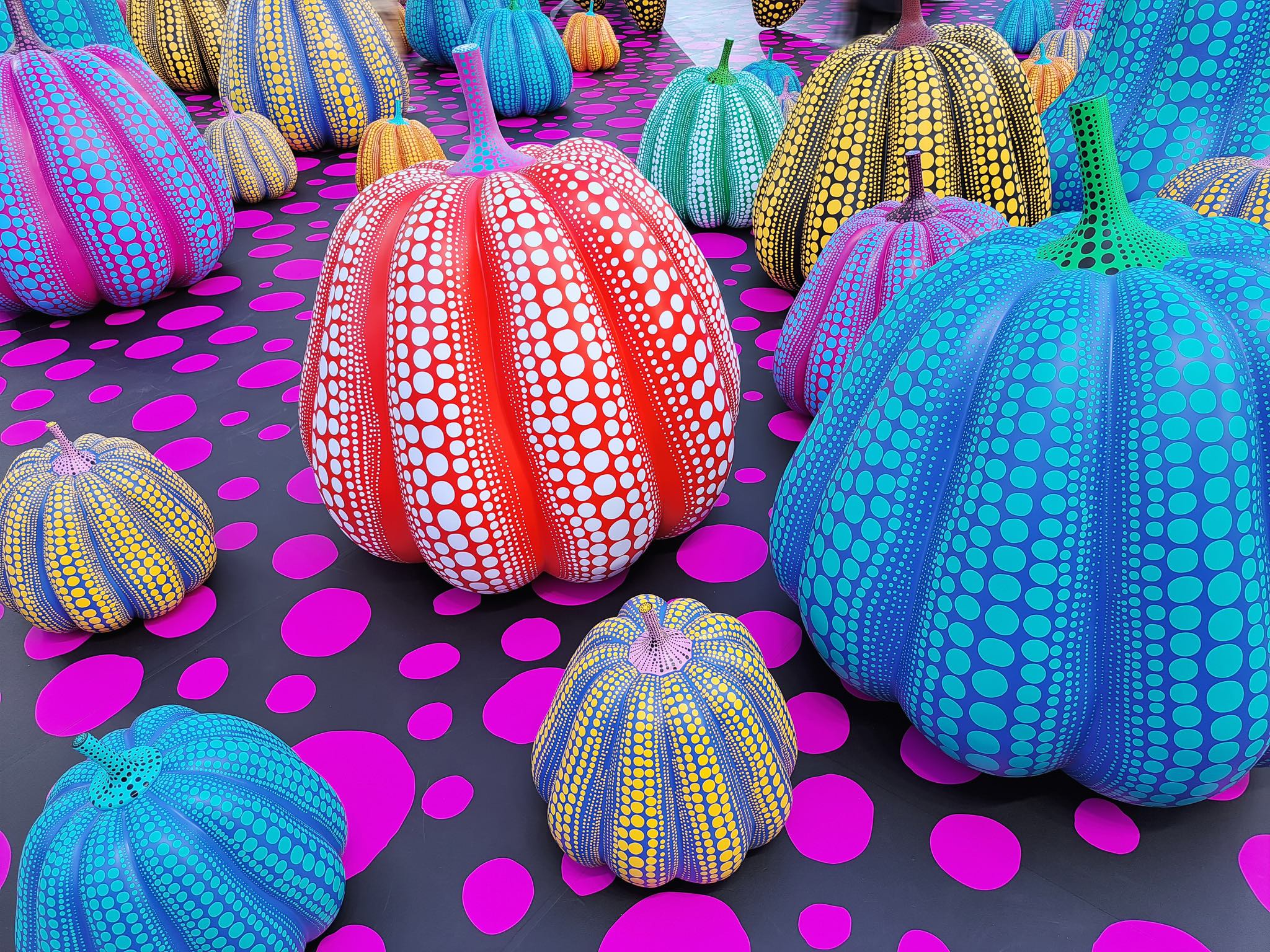
She kept working through nearly all of it. A 2024 Louis Vuitton pumpkin bag, built on a collaboration she'd first started in 2012, sold at Christie's for $151,200, a record for the brand. She published poetry and seven novels. She never stopped painting.
What's Still Standing
The Stedelijk Museum in Amsterdam had a Kusama exhibition already running when she died. It didn't close. It became something else instead, a room full of her work that visitors now walk through knowing it's the last time some of these pieces will be new in quite this way. That's its own kind of self-obliteration, in reverse: the artist disappears, and the pattern she made keeps expanding into the space she left behind.
Carousel doesn't carry Kusama's own work, but two artists in the gallery's program are working the same territory she spent her life in, from angles she'd likely have recognized.
Hamilton Aguiar's newest Optical series pieces are painted in oil directly onto mirrored plexiglass. Where Kusama built entire rooms out of reflection and light to fold a viewer into the piece, Aguiar does it at the scale of a single canvas: stand in front of one, and the room, and you, become part of the composition whether you meant to or not.
Learn More About Hamilton Aguiar
Nemo Jantzen's Thread Works are built from a single continuous line, thousands of passes of thread between hundreds of nails, until a portrait assembles itself from a distance and dissolves into pure structure up close. It's a different technique aimed at a familiar question: at what point does a repeated, obsessive mark stop being decoration and start being the whole self, laid bare.
FAQ
How did Yayoi Kusama die? She died of multiple organ failure at a Tokyo hospital on August 14, 2026, at age 97. Her studio did not make her death public until August 27.
Why did Yayoi Kusama live in a psychiatric hospital? She checked into Seiwa Hospital in Tokyo voluntarily in 1977 to treat lifelong obsessive-compulsive disorder and hallucinations through art therapy, and chose to remain there for the rest of her life while continuing to paint daily in a nearby studio.
What does "self-obliteration" mean in Kusama's work? It's Kusama's own term for the experience at the center of her art: a pattern, usually dots or nets, repeating and expanding until it engulfs the individual object or self within it. She described it as rooted directly in the hallucinations she experienced from childhood.
Where can I see Yayoi Kusama's Infinity Mirror Rooms now? Her work is held in major collections including MoMA, Tate Modern, and the Yayoi Kusama Museum in Tokyo, and the Stedelijk Museum in Amsterdam is currently presenting a posthumous tribute exhibition of her work.
What is Yayoi Kusama's most famous work? Her Infinity Mirror Rooms and polka-dotted pumpkin sculptures are her two most widely recognized bodies of work, though her Infinity Nets paintings from the late 1950s established the visual language everything after them built on.
The Pattern Keeps Going
Thirteen days of silence, at the end of a life spent trying to disappear into pattern in front of everyone. It reads, in hindsight, less like an oversight and more like the last brushstroke.
Kusama spent seventy years turning a mind that wouldn't stay quiet into rooms other people could stand inside and, for a minute, forget themselves in too. The dots didn't stop when she did.
Explore Hamilton Aguiar's and Nemo Jantzen's work at Carousel Fine Art, or browse the full roster to see where else that same instinct is still alive.