

Spider-Man is falling toward you.
That's the first thing you notice in Onemizer's Wild Spider, before the black background registers, before you clock the dense, inked linework built up like fresh tattoo work under gallery light. He isn't swinging between buildings. He isn't mid-punch. He's falling, straight at whoever's standing in front of the canvas, and there's nowhere else to look.

He's having that effect everywhere else this year too. Tom Holland put the suit back on for Spider-Man: Brand New Day, and within a week it was the highest-grossing movie of 2026. The trailer broke a viewing record before a single ticket sold. For a character who started out as a scrawny kid nobody in his comic believed in, that's a strange kind of vindication.
It's not the first time. Sixty-some years ago, a much smaller audience had the opposite reaction to a man in a comic panel, and the argument that started then is still the one worth telling now.
A Painter, a Toothbrush, and an Accusation
In 1963, Roy Lichtenstein spent days on a single canvas, pressing paint through a perforated metal stencil, one dot at a time, to blow up a single panel from a war comic to the size of a billboard. He called it Whaam! A fighter jet. A rocket. An explosion in his now-famous dots, one word in yellow.

He hadn't invented that image. He'd copied it, nearly line for line, off a five-cent comic. Critics said so, loudly. If enlarging someone else's panel counted as painting, where exactly was the art?
Lichtenstein never really argued back. He just kept painting. The image had already been seen by millions of kids on spinner racks in drugstores. Rendering it by hand, dot by dot, at a scale no comic page could touch, wasn't theft. It was asking why the picture stopped counting the moment somebody noticed it was good. Whaam! hangs in the Tate now. Nobody asks anymore.
The Man Who Drew Spider-Man Disappeared
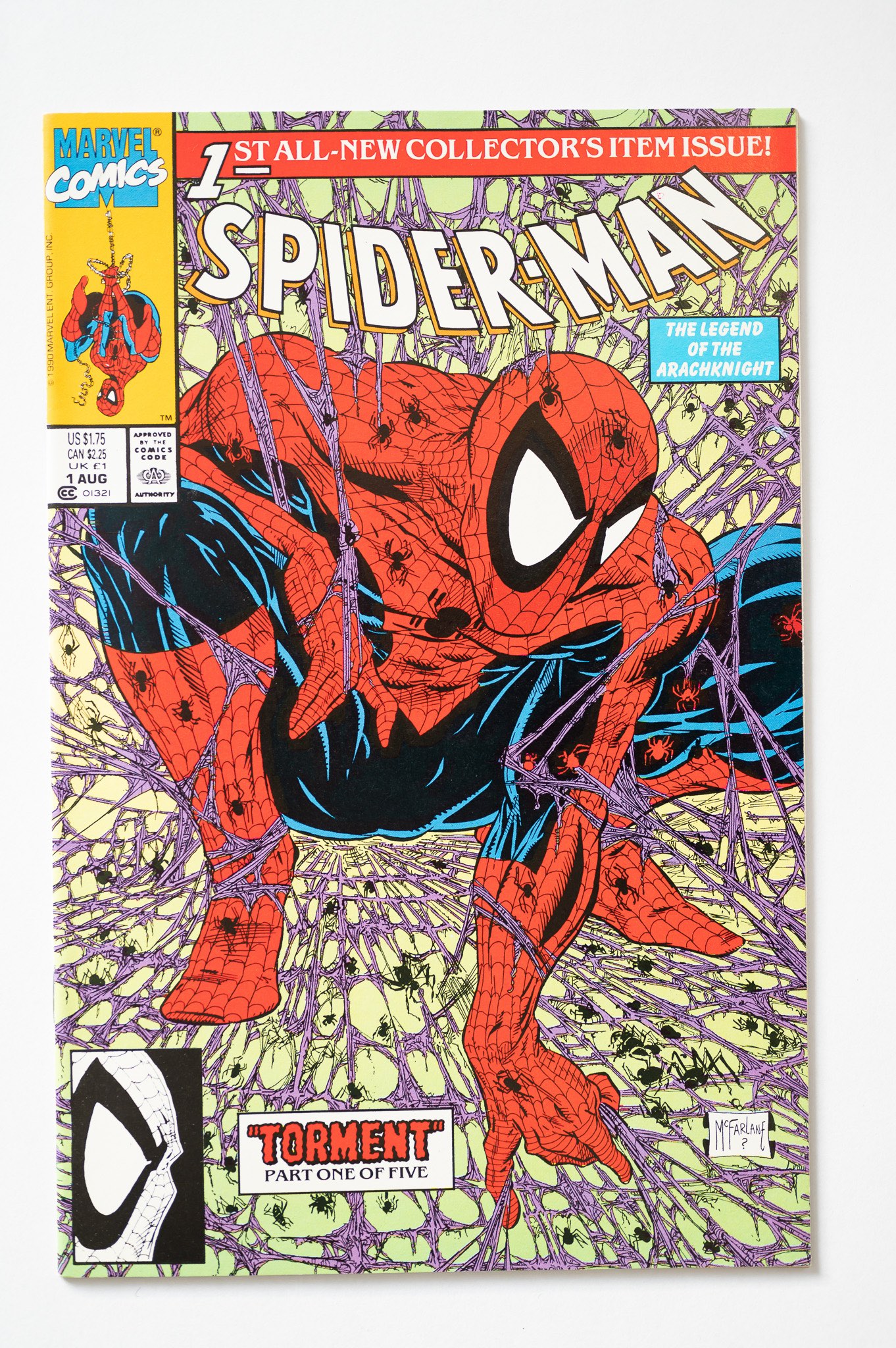
Lichtenstein didn't invent Spider-Man. A quieter man did. Steve Ditko drew Peter Parker with a nervy, off-balance posture no other superhero on the stands had in 1962, a body that looked like it was still figuring out what it could do. Then the character made him one of the most famous artists in comics, and Ditko did something almost nobody in his position does. He disappeared.
No interviews, for the rest of his life. No photographs. A man who spent his career drawing a hero who hides his face from everyone he loves chose, eventually, to hide his own. It's a strange, quiet irony sitting underneath everything Spider-Man has become: the character is a global brand now, plastered across a trailer 718 million people watched in a day, and the man who gave him his shape wanted no part of being known.
Wonder Woman's creator went the opposite direction. William Moulton Marston, a psychologist by training, built her in 1941 to win her fights with truth instead of force, a golden lasso instead of a fist. She turns 85 this year. Eighty-five years of the same quiet question Ditko's disappearance raises from the other side: what do we actually owe the person behind the persona?
What Carousel's Artists Are Still Asking
Three artists at Carousel are circling that same question right now, at the exact moment the culture can't stop talking about a man in a mask.
Onemizer didn't start out signing anything. Before the galleries in Paris and Dubai and Miami, he was painting hotel stairwells and abandoned warehouses across the south of France, walls he didn't own, for an audience that mostly wasn't looking for a name attached. Wild Spider carries that history straight into the canvas. The same dense, tattoo-style linework he built on brick is now built around a hero who spent his own fictional life keeping his identity off the wall entirely.
Chance Cooper made a smaller, stranger choice with his two superhero portraits. He didn't title them Spider-Man and Wonder Woman. He titled them Tony and Lisa, the names of the people, not the powers. It's the same instinct that sent Ditko into hiding and sent Marston looking for a hero who wins by unmasking liars: the person under the suit was always the actual subject. The suit is just where the eye happens to land first.
Learn More About Chance Cooper

BYĆ turns the same question into a joke with an edge. His series The Suit puts Superman's body under Batman's cowl, the wrong mask on the wrong hero, casting a shadow that doesn't belong to the face underneath. Mistaken identity is the whole gag, from an artist whose entire practice runs on things wearing the wrong skin. Worth a closer look.

FAQ
Is superhero art considered fine art? Yes. Roy Lichtenstein's Whaam!, built directly from a war comic panel, hangs in the Tate. Once a museum takes the source material seriously enough to collect it, the argument is mostly over.
Who actually created Spider-Man? Writer Stan Lee and artist Steve Ditko, first appearing in Amazing Fantasy #15 in 1962. Ditko drew the character's original look and became famously private for the rest of his life.
What is comic pop art? A strand of pop art that pulls its imagery straight from comic books and strips, using techniques like Ben-Day dots and bold outlines to bring comic-page visual language onto a gallery-scale canvas.
Why does Wonder Woman's 85th anniversary matter right now? She first appeared in All-Star Comics #8 in December 1941, created by psychologist William Moulton Marston. 2026 marks 85 years of a character still being reinterpreted by artists, Chance Cooper's Lisa among them.
Where can I see or buy this kind of work? Carousel Fine Art represents Onemizer, Chance Cooper, and BYĆ across its Miami, West Palm Beach, Atlanta, and Chicago galleries.
The Mask Was Never the Point
Come back to Wild Spider one more time. He's still falling, black background, no city underneath to catch him. Sixty years after Lichtenstein got laughed at for painting a war comic too well, nobody's laughing at a man in a mask anymore, not at the box office, and not on a gallery wall. It just took a while for anyone to look past the suit.
Onemizer, Chance Cooper, and BYĆ are represented across all four Carousel locations. Browse the artists or reach out to see the work in person.


