

Walk into Carousel Fine Art's River North gallery right now and you will find two floors that hold something they have never held before. A California sculptor who builds portraits from punching bags and reclaimed guns. A Swiss sculptor who has spent thirty years taking things away from her bronzes until only the essential form survives. New work from a Belgian artist who cuts 20,000 pieces of glass by hand to build a single portrait. This is the gallery's first summer curation in Chicago.
Michael Kalish: He Found His Practice in a Junkyard
Michael Kalish did not set out to be a sculptor. He studied psychology. He was interested in people, in behavior, in what drives human beings toward the things they choose. Then, in a junkyard somewhere in Georgia, he picked up a discarded license plate. Its color. Its texture. The way light moved across it. That was enough.
He has spent the decades since building one of the most formally distinctive practices in contemporary American sculpture. The materials are always found, always industrial, always saturated with cultural meaning before he has touched them: license plates, automobile parts, punching bags, reclaimed firearms. What he makes from them is not assemblage in the traditional sense. It is transformation. The object is not displayed; it is consumed by the work.
His monumental public installations are the most visible evidence of what his practice can do at scale. reALIze, a three-dimensional portrait of Muhammad Ali assembled from 1,300 suspended punching bags at twenty-two feet high, is both a formal achievement and a civic statement, the kind of public work that earns its place in a city. Raise the Caliber, constructed from reclaimed guns, handles the subject of violence with the formal intelligence of a sculptor rather than the grammar of protest. Both works carry the same quality that defines his gallery-scale pieces: the material is never incidental. It is load-bearing.
Kalish's work has been featured in the New York Times, Time Magazine, and Art in America. It sits in collections that include the US Embassy in Moscow, Ford Motor Company, and the CocaCola Corporation.
He arrives at Carousel Fine Art Chicago as an artist who has earned every claim made about him. "Nude in Repose" There is a particular kind of tension that Kalish creates when he takes a subject with centuries of art historical weight and meets it with the materials of the American industrial landscape.
Nude in Repose is that tension at its most concentrated. The nude, as a subject, carries everything: classical antiquity, Renaissance mastery, Impressionist experiment, the entire tradition of Western figure painting and sculpture. Kalish does not ignore that history. He walks directly into it. What results is a work that holds two registers simultaneously. From across the room, the form reads with the authority of the subject's long tradition. Up close, the materials assert themselves, unexpected, specific to this artist and this moment, a surface that could not have been made a century ago because the materials themselves did not yet exist in this cultural context. The work does not resolve that dialogue. It sustains it. That is the point.

Nude in Repose is Kalish's first work at Carousel Fine Art Chicago. Collectors who have been looking for a point of entry into his practice will not find a more compelling one.
Evelyne Brader Frank: Thirty Years of Taking Things Away
Evelyne Brader Frank grew up in Wettingen, Switzerland, in a family that understood what art was for. Her grandfather was a landscape painter. Her brother, a surrealist. Art was not a special occasion in that household. It was the language the family used to make sense of things. She enrolled in her first sculpting class in 1990. She was twenty years old. She worked in stone, soapstone, marble, concrete, ice, learning each medium until it gave her what she needed, then moving on. By the mid-1990s she had left Switzerland for Alberta, expanded her practice to bronze, and begun to develop the approach that would define the next three decades of her work: reduction.
The defining principle of a Brader Frank sculpture is what is not there. She removes everything from a piece that does not need to be present until only the essential form survives. The result is a body of work with a concentrated psychological weight that more elaborate figurative sculpture rarely achieves. The female figure is her subject, always drawn from classical mythology, always titled to match the emotional register of the form. The mythology is the frame. The sculpture consistently exceeds it.
She is represented by leading galleries in Canada and Switzerland. Her debut at Carousel Fine Art Chicago marks her introduction to the gallery's program and to a collector community that has been waiting for exactly this kind of work.
"The Kiss"
Rodin made his from marble and it became one of the most recognized works in Western art. Brancusi reduced the subject to near-abstraction and found something more essential than any representational treatment could have reached. Klimt gilded it. Every major sculptor who has approached The Kiss has brought their own formal logic to the same moment between two people.

Brader Frank brings economy. Where Rodin found drama and Brancusi found essence, she finds stillness. Two forms in proximity. The space between them as charged as the point of contact. There is nothing in this sculpture that does not need to be there, and everything that is there earns its place. It is not a work that announces itself to the room. It opens slowly, and offers more the longer it is held in attention.
For collectors who understand that the most powerful sculpture is often the quietest, this is a significant arrival.
New Works: Four Practices, Four Distinct Kinds of Seeing
Beyond the two debut artists, this summer's curation brings new work from four artists whose practices have been central to the Carousel Fine Art program. Each has arrived with something the gallery has not shown before.
Isabelle Scheltjens | "Thousand Eyes, One Soul"
Isabelle Scheltjens was born in Antwerp in 1981 and has spent her career developing a medium that has no real precedent: a glass-fusing technique in which approximately 20,000 individual hand-cut glass plates are fired together in a kiln at 800 degrees Celsius. Each portrait takes what it takes. The process cannot be rushed.
The experience of standing in front of her work is unlike anything else in the gallery. Up close, the surface is pure abstraction —color and texture and the play of light through glass, with no coherent image. Take ten steps back, and a portrait assembles itself out of those thousands of elements with a presence that no painted surface can produce, because the light is traveling through the glass rather than bouncing off it. There is a depth to the image that has nothing to do with three-dimensionality and everything to do with how the material works.

Thousand Eyes, One Soul is a title that describes the mechanics exactly: thousands of individual elements, each incomplete, forming a single consciousness at the right distance. It is a meditation on how perception works. It is also one of the most arresting works in the building. Scheltjens has exhibited in New York, Paris, Hong Kong, Dubai, Amsterdam, and London. The collectors who follow her work closely will recognise in this piece a significant development.
Nemo Jantzen | "Night Train"
Nemo Jantzen was born in The Hague in 1970 and spent his early career working as a graphic designer and billboard artist in Antwerp before relocating to Barcelona and committing fully to fine art. He works between Barcelona and New York.
What he makes is difficult to categorize, which is part of its power. Jantzen drives hundreds of stainless-steel nails into a wooden panel and threads a single continuous line of thread from nail to nail, zigzagging in precise, layered passes until an image accumulates out of nothing but tension and repetition. From a distance, Night Train reads almost photographically, a train emerging from darkness, the image sharp and cinematic. Move closer and the surface reveals itself: thread, metal, shadow, the physical evidence of a process that is as much about craft as it is about image-making. The shadows from the nails shift as you move, so the work is never quite the same twice. It lives differently at different times of day.

Trains at night carry a particular weight in the collective imagination: departure, transition, the passage of time through darkness. In Jantzen's hands, that weight is held by a technique that is itself about how things are built from almost nothing. Line by line. Thread by thread. Something whole.
Eric Alfaro | "A Vase Full of Dreams"
Eric Alfaro was born in Moscow in 1991 and raised in Cuba, where he trained at the Provincial Academy of Fine Arts. He brought his classical education to the United States and has spent the years since developing a body of work that has earned him the comparison, used often enough now to have some weight behind it, to Monet. The comparison is earned. Not because his paintings look like Monet's, but because they operate on the same premise: that atmosphere is the subject, and the depicted object is the point of entry.
His porcelain vase series, to which A Vase Full of Dreams belongs, places Saint-Cloud vases filled with flowers against grounds built from layered oil and acrylic, color over color, light finding its way through. The title is right. These are not still lifes in the traditional sense. They are not about what the vase contains. They are about the feeling that a vase filled with flowers on a particular afternoon can hold, if you are paying attention to it. Alfaro is always paying attention. His work is held in private collections across more than twenty countries.

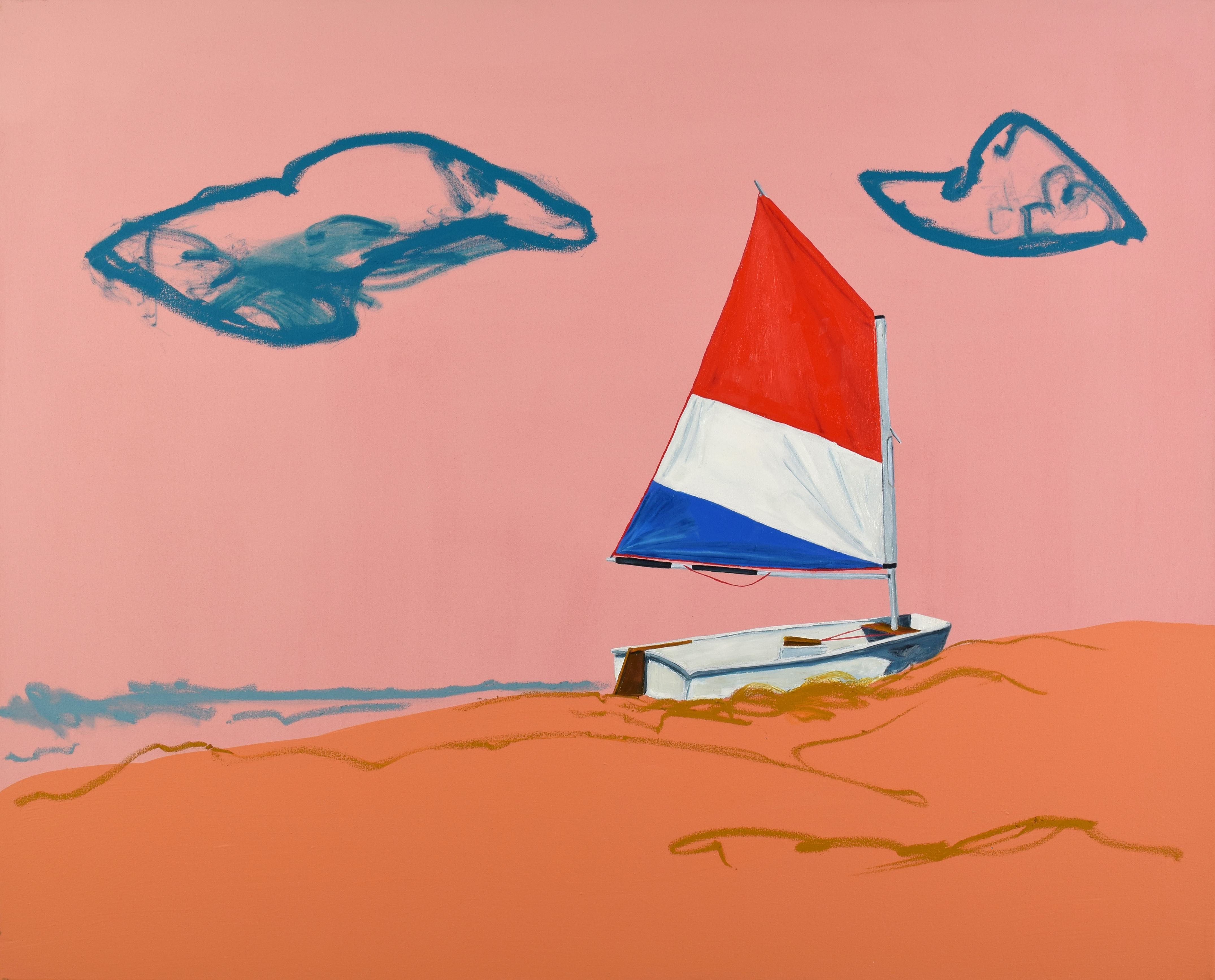
Adam Umbach | "Just Beachy"
Adam Umbach was born in Chicago in 1986, a fact that gives his return to this gallery a particular resonance. He grew up here. He left. He built a practice shaped by the maritime landscapes of East Hampton, Islesboro, and New York, and by a series of personal losses that turned him toward painting as a way of holding on to what time was taking. What he makes now is photorealistic depiction interrupted by gestural mark-making: the precisely remembered thing surrounded by the freely-made marks of someone who has learned to stop trying to hold everything exactly.
Just Beachy arrives at the start of summer and carries everything the season holds: the specific quality of coastal light, the ease of an afternoon with nowhere to be, the way certain objects collect memory without meaning to. Umbach paints with both hands, technically with one, gesturally with the other, and the two modes argue with each other on the canvas in exactly the way that the precisely remembered and the loosely held argue with each other in a person. His work has been featured in Elle Decor and Hamptons Magazine, and his collectors span New York, the Hamptons, Nantucket, Maine, and internationally.
Also in the Gallery This Summer
The summer program extends beyond the four featured works. Gregory Watin (France, b. 1976) brings urban assemblage built from materials found on building sites; wood, plexiglass, cardboard, industrial salvage, that he constructs into images of unexpected emotional weight.
Brendan Murphy (Indiana, b. 1971), whose chalkboard paintings and Spacemen sculptures are held in over 600 private collections, including those of Serena Williams, Warren Buffett, and Ryan Gosling, continues to populate his surfaces with the symbols and equations of human consciousness.
Hamilton Aguiar (Brazil, b. 1965) works in oil and resin on copper sheets, combining gilding, acid patination, and liquid resin into seascapes and landscapes of luminous, almost ancient quality. And Zhuang Hong Yi (China, b. 1962), whose flowerbed works are built from hundreds of individually folded pieces of painted rice paper, shifting color and texture as the viewer moves, and whose work has been shown at the Venice Biennale and in major European museums, brings to the program a formal ambition that belongs on any wall it occupies.

Frequently Asked Questions
Who is Michael Kalish?
Michael Kalish is a California-based sculptor born in Atlanta, Georgia in 1973. He is known for transforming found industrial materials — license plates, automobile parts, punching bags, reclaimed firearms — into formally rigorous sculpture of emotional and conceptual weight. His public installations include reALIze (a portrait of Muhammad Ali from 1,300 punching bags) and Raise the Caliber (constructed from reclaimed guns). His work is featured in the New York Times, Time Magazine, and Art in America, and sits in collections including the US Embassy in Moscow, Ford Motor Company, and the CocaCola Corporation.
Who is Evelyne Brader Frank?
Evelyne Brader Frank is a Swiss sculptor born in Wettingen, Switzerland in 1970. She has worked in bronze, soapstone, and steel for over thirty years, developing a practice defined by formal reduction and figurative sculpture drawn from classical mythology. She is represented by leading galleries in Canada and Switzerland. Her debut at Carousel Fine Art Chicago in summer 2026 is her first appearance in the gallery's program.
Where is Carousel Fine Art Chicago?
Carousel Fine Art Chicago is located in the River North neighborhood. The gallery operates across two floors. For address, hours, and directions, visit the Chicago gallery page on the Carousel Fine Art website.


