

There is a particular kind of artist who doesn't adopt a technique. They invent one. Nemo Jantzen is that kind of artist.
He was born in The Hague in 1970, in the orbit of his uncle, Johnn Bakker, the celebrated Dutch comic artist behind Pep magazine's 1960s superhero parody Blook and a modernist adaptation of Dante. The studio was his first education. Bold graphic lines. Pop-culture energy. The understanding, absorbed early, that images carry ideas that words can't reach. "Art wasn't just something you made," Jantzen has said. "It was a way of seeing."
He carried that forward. Formal training at the RTO Art Academy in Rotterdam. Then Antwerp, where he painted cinema billboards by hand, before digital printing existed, before the industry expected anything other than a steady hand and thirty feet of wall. He learned to make color and gesture communicate from a distance. He learned how grand and intimate could exist in the same object simultaneously. That tension, the closeness built into something made to be seen from far away, is the central condition of everything he has made since.
After years in Belgium and extended travel through Asia and the Middle East, he settled in Spain and committed fully to fine art. His studios now are in New York and Bali. His work is restless in the way that only a genuinely curious mind produces: cosmopolitan, layered, impossible to reduce to a single movement or tradition. Pop art. Hyperrealism. Neo-Pointillism. Photography. He borrows from all of them and belongs to none of them entirely.
What he belongs to is his own practice.
Two Techniques. One Argument.
Jantzen is best known for two bodies of work: his "Thread" Works and his "Dome" Pieces.
In the "Thread" Works, he hammers hundreds of stainless steel nails into a wooden board and connects them — nail to nail, layer over layer — with a single continuous thread, working from photographic reference until a portrait assembles itself out of line and tension and shadow. Seen from across a room, the image is clear. Walk toward it, and it dissolves into structure. The closer you get, the less the portrait holds, and the more the making reveals itself.
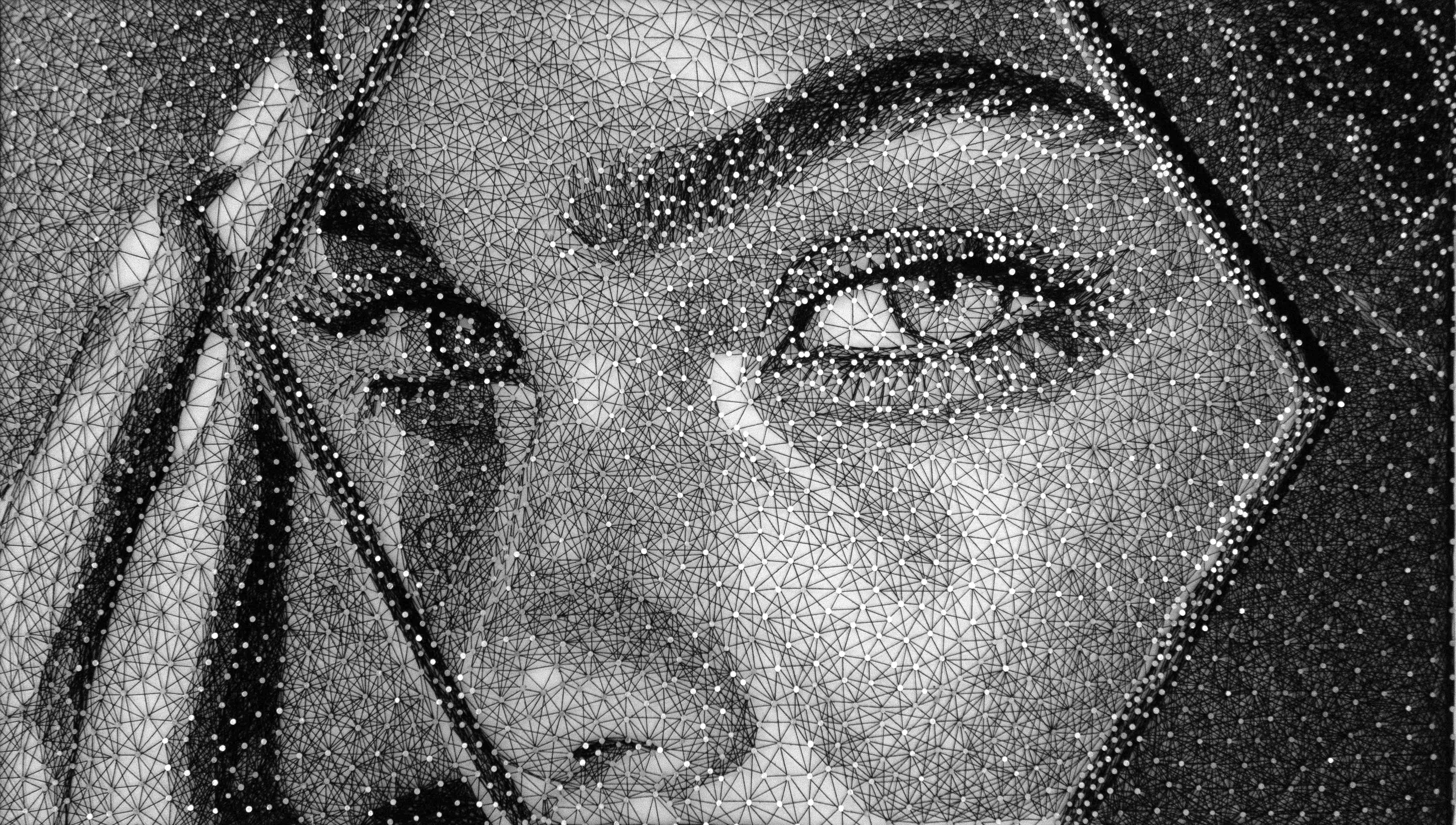
In the "Dome" Pieces, the logic inverts. He collects thousands of photographs and cinematographic stills, embeds them in small hand-formed resin spheres, then assembles those spheres into large-scale wall sculptures. The portrait only exists from a distance. Move toward it and the image fragments into its constituent parts, each sphere a world unto itself, each one holding images too small to read individually, too numerous to dismiss.
Both techniques ask the same question, from opposite directions: how does perception shape meaning?

Neither of them is painting. Neither is sculpture. Neither is photography. They are, in the most genuine sense of the phrase, original processes, visual languages Jantzen developed because the ones that existed didn't say what he needed to say.
What the Market Knows
The "Dome" Pieces debuted at Art Basel Scope Miami in 2015. They sold out immediately.
That is not a small thing. Art Basel Miami is not a context in which work sells on hype or novelty. The collectors and advisors who move through that fair have seen everything, multiple times. They are not impressed easily. The complete sell-out of Jantzen's debut "Dome" exhibition reflects something more durable than moment: it reflects work that earned its room.
The institutional response has been consistent. His work is held in the permanent collections of the GEM Museum in the Netherlands, Museum POPA in Switzerland, Museum Diocesa in Spain, and the Peru Contemporary Art Museum, among others. Hospitality placements include the Mandarin Oriental Hotel in New York and the Presidential Suite of the Mandalay Bay Resort in Las Vegas.
Private collectors include Claudia Schiffer. Kobe Bryant, commissioned. Ronnie Wood of the Rolling Stones, also commissioned.

He has shown at Art Miami, Art New York, the LA Art Show, Istanbul Contemporary, Sydney Contemporary, Art Karlsruhe. For two decades, across four continents, in every context where serious contemporary art is presented, Jantzen's work has been present and acquired.
That record is not incidental. It is the argument, made in the language the market speaks.
Why It Matters to Live With
Collectors who have followed Jantzen's practice describe a consistent experience: the work changes on you.
Not in a metaphorical sense. Literally. The "Thread" Works shift as ambient light moves through a room. A piece that reads as high-contrast and graphic in morning light softens in the afternoon; at night, under artificial light, it becomes something else again. The "Dome" Pieces scatter light differently as you move past them, revealing new relationships in the embedded imagery that weren't visible from any previous angle.

You do not exhaust a Jantzen. That is rarer than it sounds.
At Carousel Fine Art
We represent Nemo Jantzen because his work does what the best contemporary art should do: it earns sustained attention, not just first impressions.
His "Thread" Works — including Sun-Rays (Black Edition), Don't Look Back, Mirroview, Jetset Black, Hello Summer, California, Tiffany's, Oceans, and Night Train — and his "Dome" Pieces — Galactic, Dolce Vita, Bella Italia, and others — are among the most technically original and visually commanding works we handle.

They are also, in any room they occupy, the first thing you see when you walk in.
And the last thing you stop looking at before you leave.
Frequently Asked Questions
Who is Nemo Jantzen? Nemo Jantzen (b. 1970, The Hague) is a Dutch contemporary artist known for two signature bodies of work: "Thread" Works, constructed from stainless steel nails and continuous thread, and "Dome" Pieces, large-scale wall sculptures built from hand-formed resin spheres encasing thousands of photographic images. His work is held in museum and private collections worldwide and has been exhibited at Art Basel Scope Miami, Art Miami, Art New York, and major international fairs across Europe, Asia, and Australia.
Where has Nemo Jantzen's work been shown? Across two decades: Art Basel Scope Miami, Art Miami, Art New York, the LA Art Show, Istanbul Contemporary, Sydney Contemporary, Art Karlsruhe, and institutions and galleries in London, Amsterdam, Singapore, Seoul, Paris, and Berlin, among many others.
Who collects Nemo Jantzen's work? Institutional collectors include the GEM Museum (Netherlands), Museum POPA (Switzerland), and the Mandarin Oriental Hotel New York. Private collectors include Claudia Schiffer, Kobe Bryant (commissioned work), and Ronnie Wood (commissioned work).
What is the difference between the "Thread" Works and the "Dome" Pieces? The "Thread" Works are built from hundreds of stainless steel nails and a single continuous thread on a wooden ground, three-dimensional portraits that shift as light and viewing angle change. The "Dome" Pieces are large-scale wall sculptures assembled from hand-formed resin spheres, each containing thousands of embedded photographic images, that resolve into a portrait only from a distance. Both bodies of work engage questions of perception and meaning. They approach those questions from opposite directions.
How do I inquire about Nemo Jantzen's work? Contact Carousel Fine Art to discuss available works, pricing, and collector consultations. Private viewings can be arranged.
Take Away
Nemo Jantzen did not arrive quietly, and he has not stayed quiet.
From the billboard walls of Antwerp to sold-out Art Basel rooms, from museum permanent collections to the private walls of collectors who know what they're looking at, his trajectory is what a serious practice looks like when the work is genuinely doing the work.
There is a Jantzen thread piece currently available through Carousel Fine Art that stops people in the gallery. Not because it is technically extraordinary, though it is. Not because the image is immediately striking, though that too. It stops them because it keeps changing, and they can't figure out when to stop looking.
That's the one worth calling about.
