

Carousel Fine Art had the privilege of speaking with Sylvain Tremblay, the Quebec-based sculptor painter whose work explores the nuances of material, dimension, and emotional storytelling. Known for his highly textured surfaces and unmistakable visual language, Tremblay's practice has evolved across mediums, continents, and large-scale art commissions. Watch The Full YouTube Video Below
In this edition of Art Talk: Artist Interviews, collectors are invited to take a deeper look into Sylvain Tremblay's artistic process, Miami studio residency, and bespoke commission work, while highlighting defining series such as his iconic Klein Blue works, and landmark achievements including one of the largest sand portraits ever created, executed by hot air balloon.
Sculptor Painter: Redefining Contemporary Textured Art
Sylvain Tremblay is widely recognized as a sculptor painter, a distinction that defines his place within contemporary art and textured painting.
His works move beyond traditional flat canvases, incorporating depth, relief, and physical structure. Rather than working on a two-dimensional surface, Tremblay builds outward, creating a tactile, sculptural experience. This dimensional approach has positioned his work within the growing demand for sculptural wall art and fine contemporary textured paintings.

Evolution of Technique: From Concrete to Modeling Paste
A pivotal moment in Sylvain Tremblay's artistic evolution came with his transition from concrete to modeling paste.
Early in his career, concrete allowed him to explore weight, permanence, and raw materiality-challenging traditional painting methods. Over time, he refined his process, adopting modeling paste to achieve greater precision, flexibility, and control over texture.
This evolution enabled a more fluid and expressive outcome, allowing his figures and compositions to emerge with dimensional complexity. At its core, this shift reflects a defining characteristic of Tremblay's practice: continuous experimentation, material innovation, and a refusal to remain static within contemporary art conventions.
Resin, Varnish, and the Search for a New Visual Language
One of the most defining breakthroughs in Tremblay's work came through his experimentation with resin, varnish, and matte versus glossy surfaces in contemporary painting.
His exploration began unexpectedly. While incorporating wire into his paintings, he needed a way to secure the material. This led to Sylvain experimenting with varnish as an adhesive and finishing layer. He immediately responded to the effect it created, particularly the way it enhanced depth and reflection.
However, Tremblay became intentional about pushing beyond conventional use. While he appreciated the aesthetic of varnish, he did not want his work to mimic other artists who rely heavily on glossy finishes across the entire surface.
Instead, this tension led to a defining innovation in his practice: he began strategically separating matte and glossy surfaces within the same composition.
- The backgrounds are finished in glossy resin or varnish, creating depth, reflection, and visual expansion
- The subjects remain more matte and dimensional, allowing them to physically and visually stand forward from the surface

This contrast became central to his identity as a contemporary sculptor painter. It allows his subjects to stand out with greater clarity and presence, while the background recedes into a reflective, almost atmospheric field.
More importantly, this discovery reflects Tremblay's ongoing philosophy: to continuously experiment and create a style that has not been done before. His process is defined by curiosity and a refusal to settle into a fixed visual language.
The Klein Blue Series: Color, Emotion, and Contemporary Romanticism
Among the most recognizable bodies of work in Sylvain Tremblay's portfolio is his Klein Blue series, inspired by Yves Klein and reinterpreted through a distinctly emotional and contemporary lens.
While rooted in the intensity of Yves Klein Blue, Tremblay's interpretation moves beyond pure abstraction or conceptual monochrome. His series introduces a softer, more romantic visual language, where the blue becomes a carrier of emotion rather than just a formal color choice.
In this body of work, figures often appear in states of peace, affection, and contemplation. Couples are shown in quiet moments of closeness, bodies leaning into one another, gestures softened by stillness. There is a sense of calm that runs through the compositions, an intentional departure from tension and hardness.
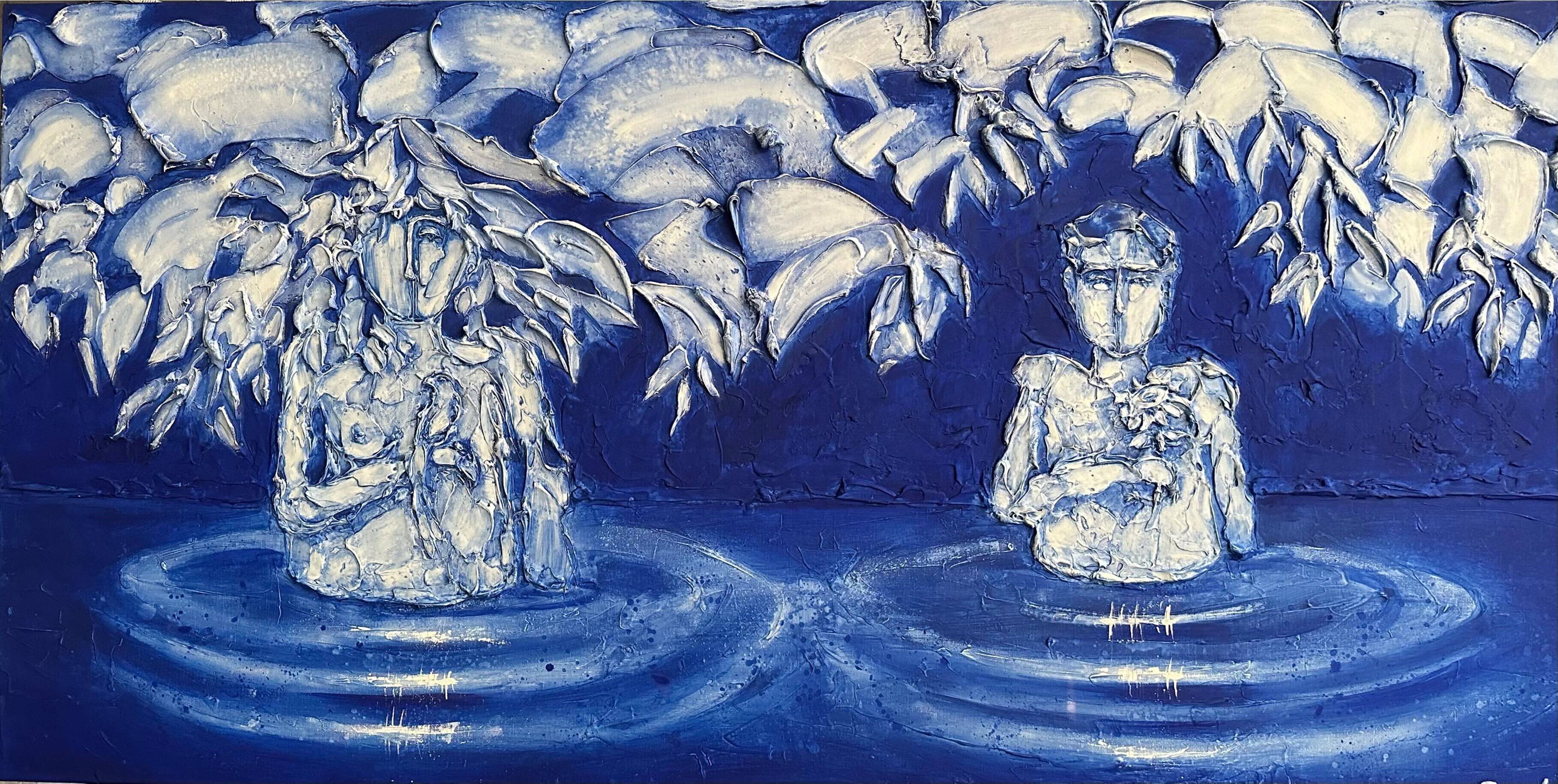
The Klein blue color plays a central emotional role. Rather than overpowering the image, it surrounds and elevates the subjects, amplifying feelings of serenity, love, and human connection. The color becomes atmospheric, almost like a shared emotional space the figures exist within.
In Tremblay's work, blue, peace, and love are interconnected themes. The hue is not only visual but symbolic: it creates a meditative field where emotion is distilled into its purest form. This gives the series a distinctly poetic quality, making each piece feel both intimate and universal.
Through this approach, Tremblay redefines what a Klein Blue inspired contemporary art series can be. It is no longer just about color theory or artistic homage, it becomes about human experience, emotional stillness, and romantic connection within a modern sculptural painting practice.
A Global Practice Shaped by Movement
Sylvain Tremblay's career has spanned multiple countries, with each location influencing his artistic language. From Montreal to China, Bushwick to Dubai, his international experience has shaped both his materials and conceptual approach.
This global perspective is reflected in his work, where abstraction meets figuration, and personal narrative intersects with universal themes. His pieces resonate with collectors worldwide, not only for their visual impact, but for their sense of place, movement, and lived experience.
Landmark Commission: Portrait of Sheikh Zayed
One of the most defining moments in Sylvain Tremblay's career is his monumental portrait of Sheikh Zayed bin Sultan Al Nahyan, commissioned in 2014 for the Canadian Embassy's anniversary in the UAE.
Created in the Dubai desert, the work functioned as both a portrait and a large-scale performance artwork, merging land art, experimentation, and cultural tribute.
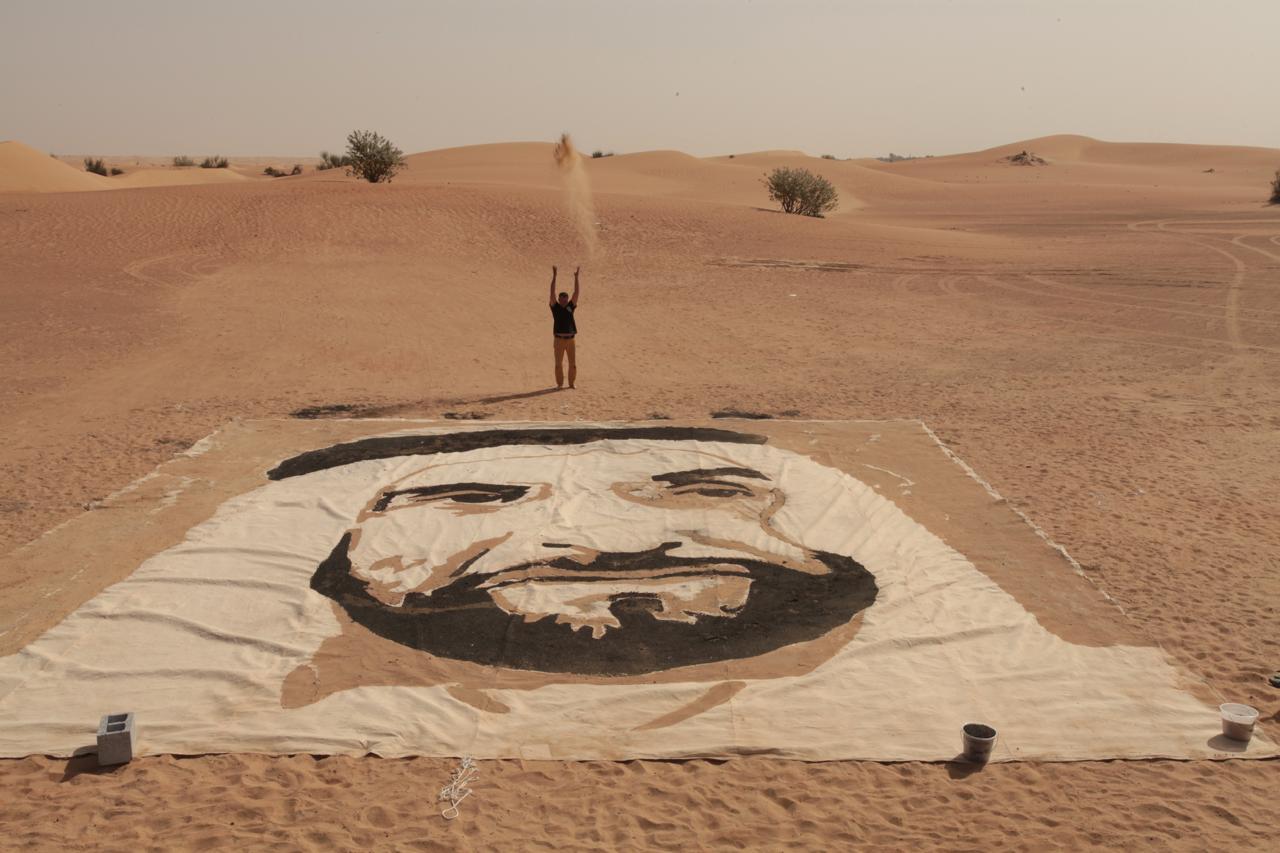
Using a hot air balloon, Tremblay developed a highly unconventional technique, dropping layers of sand from above to construct the portrait using three tonal variations. This process required precision, control, and repeated elevation, making the creation itself as significant as the final piece.
Despite challenges such as wind, shifting desert conditions, and a crash landing, the portrait was successfully completed at a monumental scale and is widely recognized as one of the largest sand portraits ever produced. (At the time, it was the largest sand portrait created in the world.)
This project established Tremblay's reputation for experimental portraiture, performance-based art, and large-scale commissioned works, demonstrating his ability to push artistic boundaries beyond the studio.
Commission Work: Experimentation, Storytelling, and Collector Collaboration
A defining strength of Sylvain Tremblay's practice is his ability to bring innovation and experimentation into art commissions.
For Tremblay, a commission is never a repetition, it is a collaborative, evolving process.
In the interview, he reflects on two significant commissions created for a Carousel Fine Art collector: portraits of Mozart and Vincent van Gogh. These works exemplify his ability to merge collector vision with his own sculptural and conceptual approach.
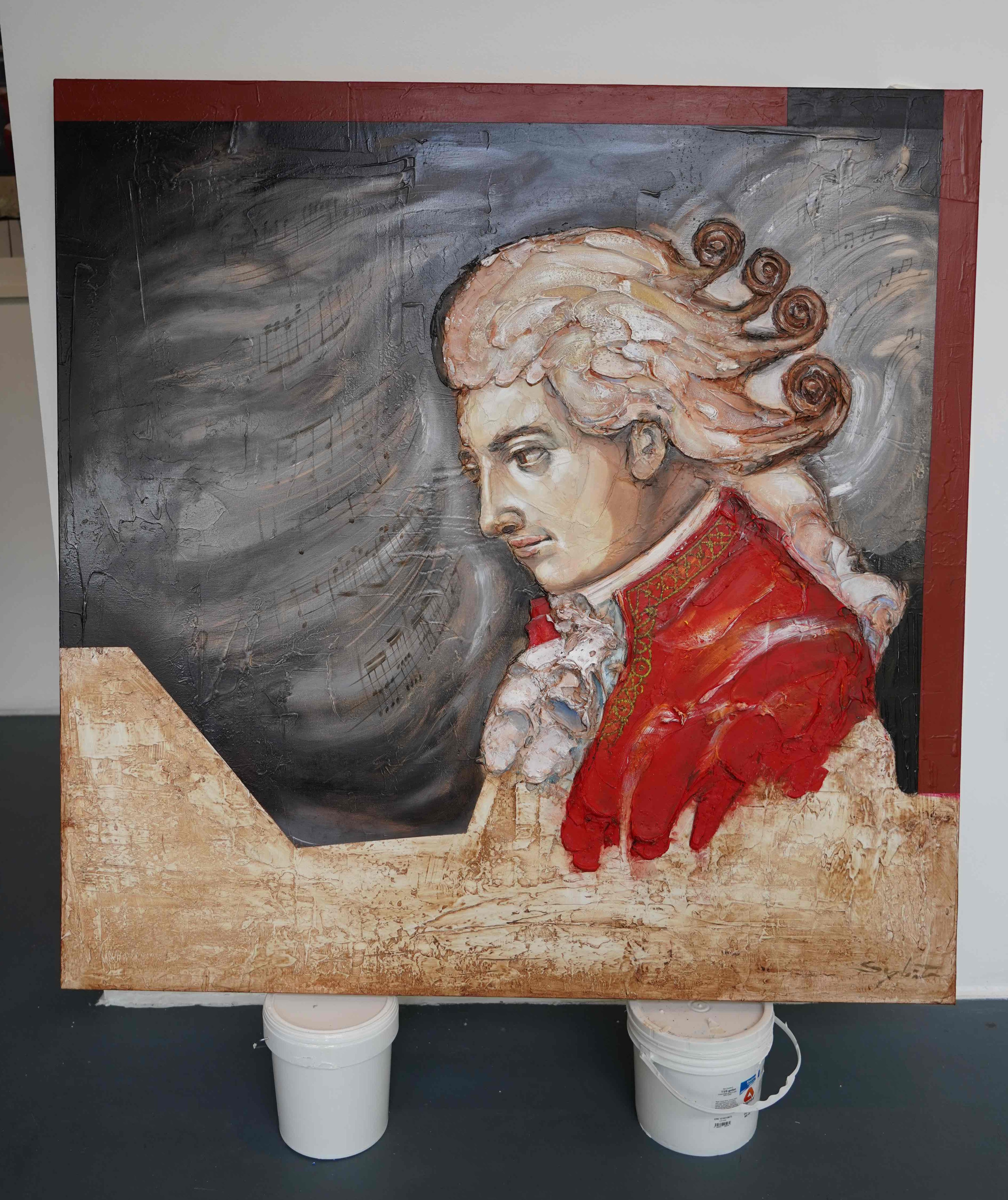
Each project begins with a hand-drawn sketch, developed through close dialogue with the collector. From there, Tremblay builds his own narrative into the work, ensuring it is both personally meaningful and artistically authentic.
In the Van Gogh piece, for example, he incorporates symbolic elements such as the sunflower motif, alongside subtle references to the artist's identity, transforming the work into layered storytelling rather than simple portraiture.
Once the sketch is approved, Tremblay moves into his signature layered process: he begins with modeling paste, building dimensional structure directly onto the surface. This is followed by painting, layering tone, texture, and color; and then the final phase where he introduces refinement through varnish, resin, or additional sculptural detailing. Each stage adds depth, turning a concept into a fully realized, textured work.
For these commissions, Tremblay established a working studio inside Carousel Fine Art's Miami gallery, creating a micro-residency where collectors could witness the works in progress. This ability to create anywhere in the world defines his practice. His studio is fluid: adapting to each project, environment, and collector relationship.
The Artist Interview: A Closer Connection
This Art Talk: Artist Interview with Sylvain Tremblay offers more than insight into process, it reveals artistic evolution rooted in constant experimentation, evolution, material development, and conceptual storytelling.
From his early use of concrete to his later exploration of modeling paste and resin, Tremblay continues to expand the boundaries of contemporary sculptural painting.
Whether working on his Klein blue series, historical portrait commissions, or large-scale sculptural canvases, Tremblay's approach remains consistent-push further, build deeper, and never repeat what has already been done.
Discover Available Works & Commissions
Collectors interested in acquiring or commissioning works by Sylvain Tremblay are invited to connect with Carousel Fine Art to explore available artworks, Klein Blue series pieces, and bespoke contemporary art commissions.
