

A Bouquet That Won't Hold Still
Look at Morning Blooms for more than a few seconds and something moves the eye. The bouquet, sixty inches of pink, purple, orange and yellow flowers blooming from a glass jar, sits on a table that should be still. It is not. Bands of pale color run horizontally across the canvas like a photograph taken through a rain-streaked window, or a memory unfolding in real time. Some flowers are still, others fall to the table. The air around them is smeared.
That smear is the whole point of Eric Alfaro's Blossom Series.
The Cuban-born, Miami-based painter unveiled the series at Carousel Fine Art's Spring Reverie exhibition in May 2024, and it has since become one of the gallery's most collected bodies of work, moving through showrooms in the United States and across the globe. On the surface, each canvas reads as a classical still life: cut flowers, a vase, a table, a wall behind it. Alfaro then disrupts that stillness on purpose, and the disruption is what a viewer actually remembers.
Where the Series Comes From
Alfaro has said the Blossom Series grew directly out of two earlier bodies of work: his Water Lilies paintings, which he began as a student steeped in Impressionism, and his broader nature landscapes. Where those series stayed closer to observed reality, Blossoms pushes toward something more expressionist and more figurative in its handling of paint, even though the subject, a bouquet in a vase, could not be more traditional.
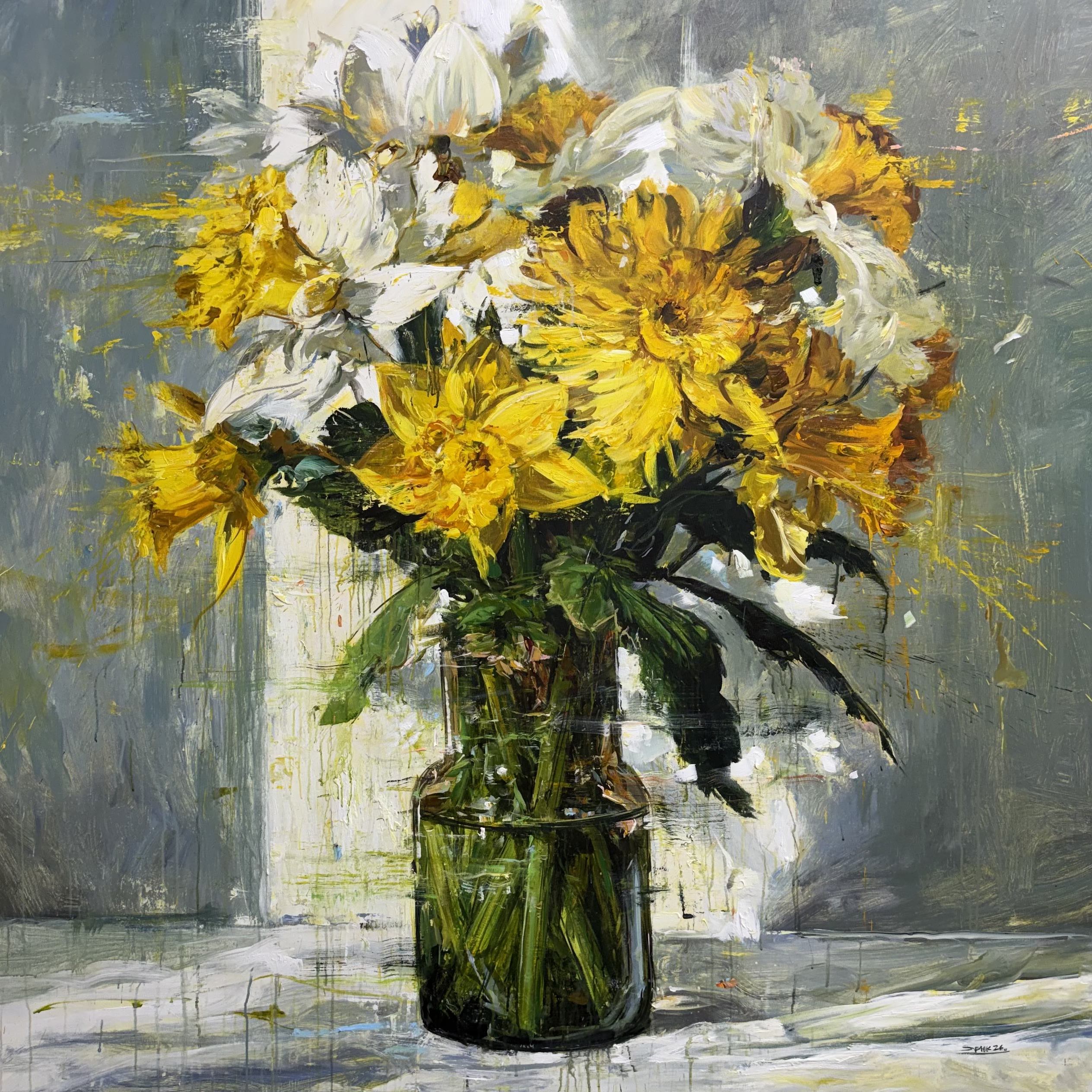
The specific flower behind much of the series is the cherry blossom. Alfaro has spoken about being drawn to it for a reason that goes beyond its color: it opens for a matter of days each year, then falls. "It reminds us how momentary life can be," he has said of the flower, describing it as a small, recurring rebirth. That idea, rebirth on a deadline, is the emotional engine of the entire series, whether the canvas shows cherry blossoms specifically or the loose, multicolored spring bouquets that recur throughout the body of work, as in First Glance and Our Story.
The Technique: Building Up, Then Wiping Away
Alfaro paints the Blossom Series in two distinct motions, and both are visible if you stand close to the canvas.
The build. Working in oil on linen or acrylic on canvas, Alfaro layers paint with brush, palette knife, and at points his own hands, until individual petals rise off the surface in thick ridges of impasto. This is not decorative texture. It gives each bloom physical weight, so that a work like Blooming Love, with its cascade of various colored flower species spilling from a floral porcelain vase, has a topography you can almost read with your fingers before you read it with your eyes.
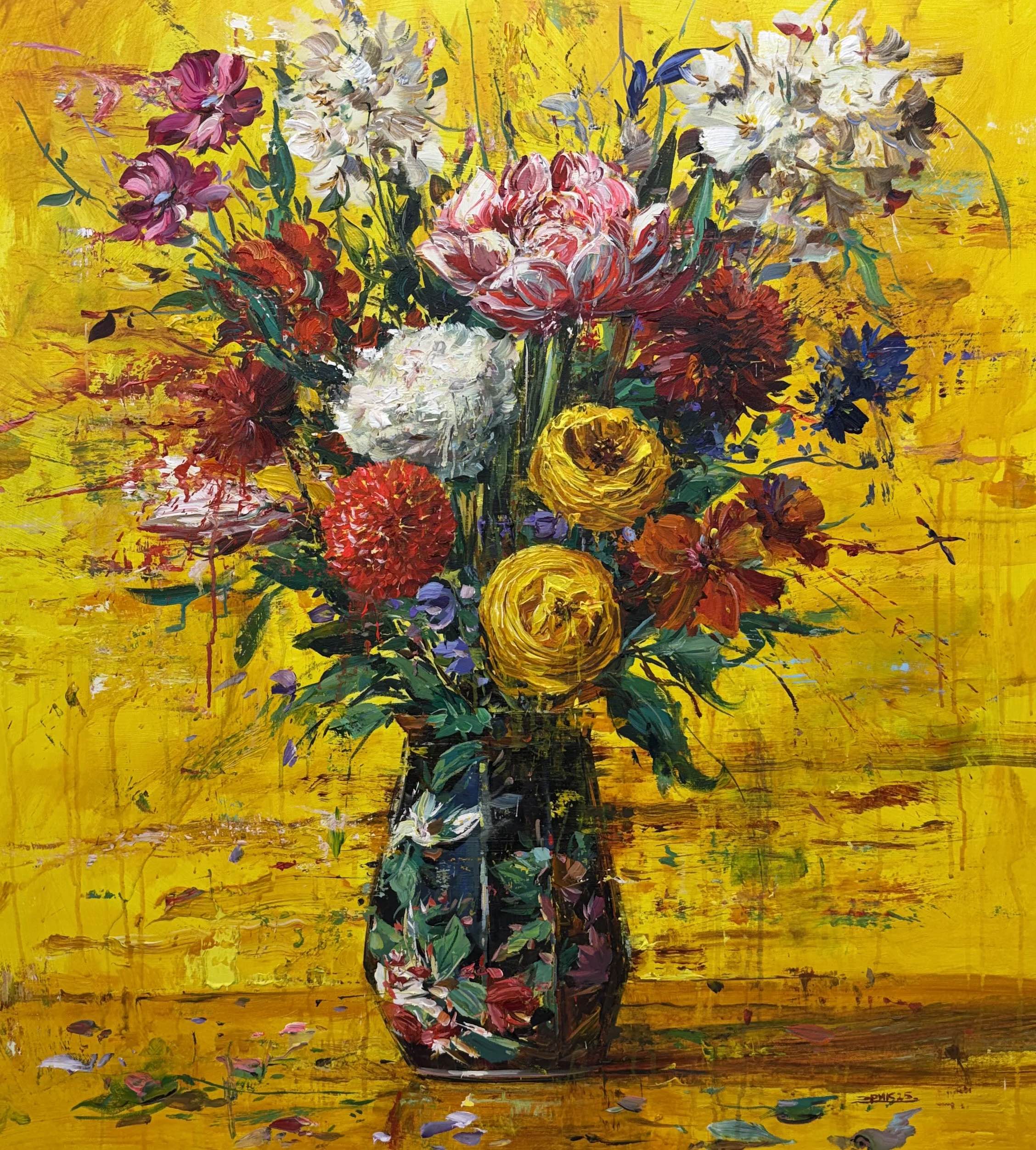
The disruption. Once the floral forms are established, Alfaro drags fresh paint horizontally across sections of the still-wet canvas. The gesture blurs the background, the tabletop, sometimes the vase itself, while leaving the flowers largely intact. The effect reads as motion, or as time passing mid-frame, the visual equivalent of a long camera exposure. It is why the series feels alive rather than arranged: the bouquet is caught between the moment it was cut and the moment it will wilt.
The result sits in a specific lineage of still life painting, one that runs through Dutch vanitas painting and into the Impressionists, where a bowl of fruit or a vase of flowers was never just decoration but a quiet reminder that beauty has a clock running under it. Alfaro's contribution is to make that clock visible as a formal gesture, not a symbol buried in the composition.
The Works Collectors Ask About Most
The series ranges widely in scale and palette, which is part of why it works across such different interiors.
Wait For Me at 78 by 78 inches in oil on linen, is one of his largest statement piece available, a wall of color meant to anchor a room rather than accent it. Loving You and New Beginnings, both 36 by 36 inches, work at the opposite end of the scale, intimate enough for a hallway or a reading nook, monochromatic enough (red-on-red in one, blue-on-blue in the other) to read as almost abstract from across a room. Rising, in oil on linen, pairs a blue and white chinese porcelain vase with blooming water lilies in a composition that leans more classical, useful for interiors built around chinoiserie or traditional millwork. First Glance and If I Think About You, sit in between, sized for a stairwell landing or above a console, and both were staged in Carousel's design partnerships to show how the work reads against warm neutrals and against cooler, more minimal palettes.

Collectors researching the series should treat scale as the first decision, not the last. A 30-inch study and a 120-inch canvas are different objects with different jobs in a room, even when they share a palette and a hand.
Where the Blossom Series Belongs in a Room
Interior designers have gravitated to this series for a specific reason: it holds its own in a room without fighting the architecture. The impasto gives the work enough physical presence to anchor a large wall, while the smudged, atmospheric background keeps it from reading as a hard-edged focal point that competes with furniture or millwork. It works over a sofa, above a mantel, or as the single statement piece in an entry, and it tends to read equally well against warm traditional interiors and cooler contemporary ones, a flexibility Alfaro's earlier work has also been recognized for.
FAQ
What is Eric Alfaro's Blossom Series? The Blossom Series is a body of floral still life paintings by Cuban-born artist Eric Alfaro, first shown at Carousel Fine Art's Spring Reverie exhibition in May 2024. Each work combines thick impasto flowers with smudged, motion-blurred backgrounds, built in oil on linen or acrylic on canvas.
Why does Eric Alfaro smudge the paint in his floral paintings? Alfaro drags fresh paint horizontally across the canvas while it is still wet to suggest time passing within a single still life. The technique gives the flowers a sense of transience, catching the bouquet between full bloom and the moment it fades.
What sizes does the Blossom Series come in? The series spans roughly 24 by 18 inches for intimate studies up to 80 by 120 inches for large statement canvases, with many works produced in the 30-inch and 78-inch square formats.
Is the Blossom Series painted in oil or acrylic? Both. Alfaro works in oil on linen for several key pieces and in acrylic on canvas or linen for others. The medium affects surface sheen and blending, not the underlying technique.
Where can I see or acquire a work from the Blossom Series? Carousel Fine Art represents Eric Alfaro across its Miami, Atlanta, West Palm Beach and Chicago locations. Availability changes as pieces sell, so reach out directly for current inventory and studio visit requests.
A Bouquet, Still Moving
Return to Morning Blooms one more time. The flowers are still sharp. The room around them is still dissolving. That tension, precision against blur, bloom against fade, is the reason the Blossom Series has become one of Carousel's most requested bodies of work rather than a passing exhibition. It does not ask to be looked at once. It asks to be lived with, the way an actual bouquet is, changing slightly every time you walk past it.
Carousel Fine Art currently holds available works from the Blossom Series across its Miami, Atlanta, West Palm Beach, and Chicago locations. Reach out to arrange a private viewing or discuss a specific canvas for your space.
External Authoritative References
- Dutch vanitas still life tradition: The Metropolitan Museum of Art, "Vanitas" heilbrunn timeline entry, for the historical lineage of flowers-as-mortality symbolism referenced in the technique section.
- Cherry blossom symbolism in art and culture: a reputable botanical or cultural source (e.g., Smithsonian or National Gallery of Art material on hanami and cherry blossom symbolism) to support the "ephemeral rebirth" framing.
