

A Library That Does Not Exist, Built From Books That Do
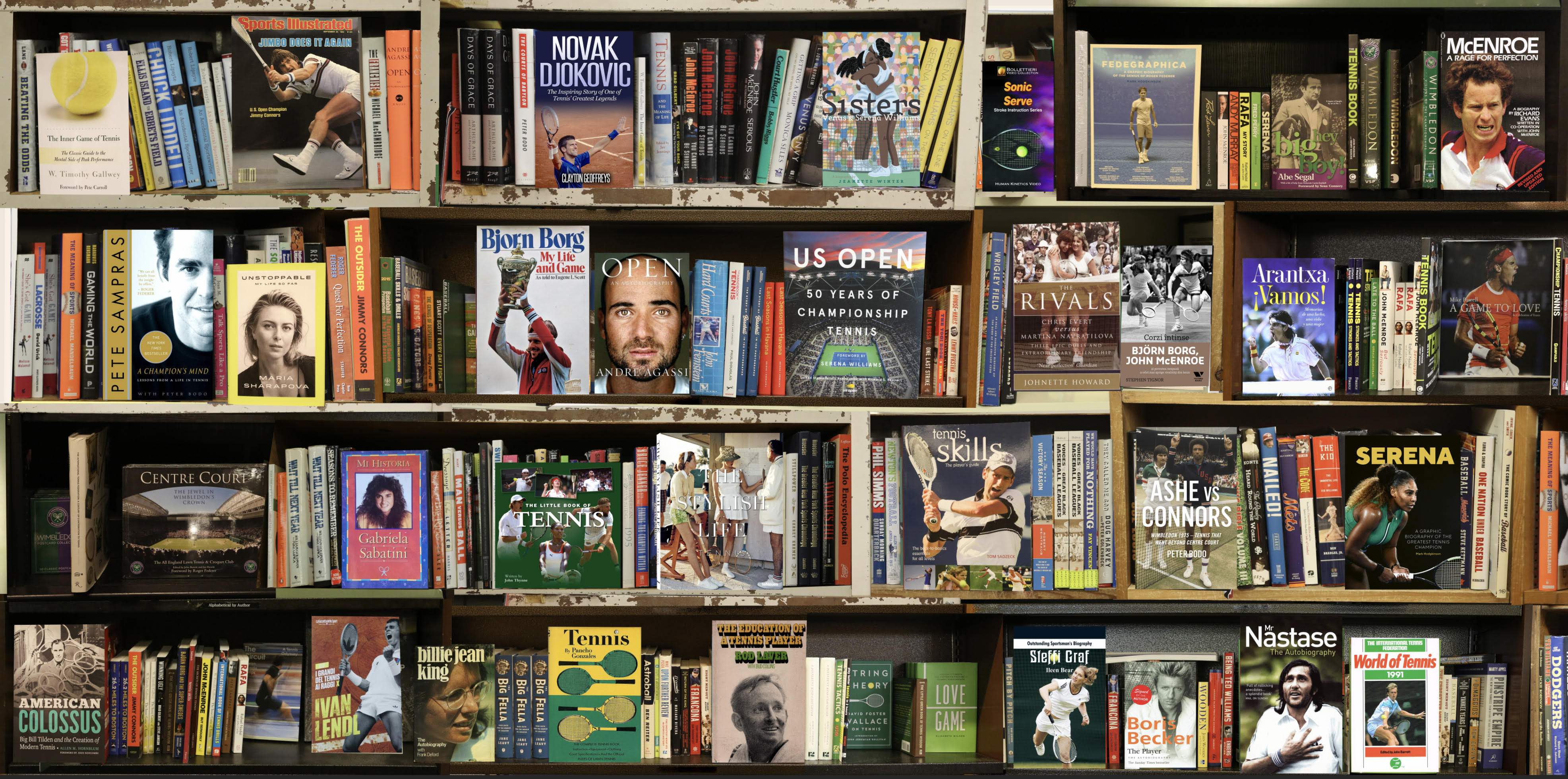
Novak Djokovic's biography sits a few spines over from Björn Borg's memoir, down the shelf from Arthur Ashe's Days of Grace, above a run of Wimbledon history books thick enough to double as a coffee table. None of these books ever shared a real shelf. Max Steven Grossman built the shelf digitally, spine by photographed spine, until the composite reads like a serious tennis library assembled over forty years by one obsessive collector. It was assembled instead by one artist, over however many bookstores it took to find that many real tennis titles.
That is the premise of Grossman's Bookscapes: photograph enough real books, then reorganize the photographs into libraries that were never actually built. Tennis (2019) is one entry in a body of work that has already done the same thing for fashion, architecture, film, and rock and roll. This one happens to arrive at the exact moment tennis is having its biggest cultural year in a decade, with Wimbledon 2026 underway at the All England Lawn Tennis and Croquet Club and "tenniscore" showing up in nearly every interior design forecast published this year.
Who Is Max Steven Grossman?
Grossman was born in Barranquilla, Colombia, in 1971. He trained first as an engineer, graduating from the University of Philadelphia in 1994, before switching direction entirely and earning an MFA in photography from New York University and the International Center of Photography in 2000.
The engineering background shows up in the work, not as subject matter but as method. Building a bookscape is closer to drafting than to painting: hundreds of individually photographed book spines, measured, color-corrected, and assembled into a composite that has to hold together as both an image and a structure. Grossman has applied that process to shelves organized around fashion, architecture, business, film, rock and roll, and sport, exhibiting the results at the Museum of Modern Art in Cartagena, Beatriz Esguerra Art in Bogotá, the Museum of Modern Art in Barranquilla, Art Wynwood in Miami, and at fairs in Switzerland, Panama, Hong Kong, and Spain.
A former engineer who now builds libraries that do not exist. That contradiction is the whole practice.
Inside Tennis: Reading the Spines
Look closely and the shelf becomes a timeline of the sport. Rod Laver's The Education of a Tennis Player and Pancho Gonzales sit near the sport's amateur-era roots. Bill Tilden appears in American Colossus, the book most tennis historians credit with modernizing the game before the Second World War. Arthur Ashe's Days of Grace and Billie Jean King's memoirs carry the sport through its civil rights and gender-equity battles. Björn Borg, John McEnroe, Ivan Lendl, and Jimmy Connors fill out the serve-and-volley era that built Wimbledon's modern television audience. Steffi Graf, Boris Becker, Gabriela Sabatini, and Arantxa Sánchez Vicario cover the 1990s. Pete Sampras, Andre Agassi, and Maria Sharapova bridge into the 2000s. Novak Djokovic, and the Williams sisters in Sisters: Venus and Serena Williams, bring the shelf into the present.

Threaded between the biographies: instructional titles like The Inner Game of Tennis, tournament histories including US Open: 50 Years of Championship Tennis and Centre Court: The Jewel in Wimbledon's Crown, and rivalry books like The Rivals: Chris Evert vs. Martina Navratilova and Ashe vs. Connors, an account of their 1975 Wimbledon final. Every title is a real, purchasable book. Grossman is not inventing tennis history. He is curating it, then photographing his own curation until it looks like a library any serious fan would recognize, and want.
That is the appeal for a collector: the work rewards close reading the way a great group show does. Stand in front of it for thirty seconds and you are skimming titles. Stand in front of it for five minutes and you are tracing the sport's entire modern history, one spine at a time.

Why Tennis Art Is Having a Moment
Wimbledon 2026 runs June 29 through July 12 at the All England Club, with the ladies' final on July 11 and the gentlemen's final closing the tournament on July 12. That alone would make tennis a live search and cultural topic for two weeks. But the timing runs deeper than the tournament calendar. Design forecasters have spent 2026 tracking "tenniscore," a sportsluxe aesthetic built on Wimbledon whites, citrus and lime accents, and heritage sports branding, as one of the year's defining interior looks. Vintage rackets on gallery walls and oversized tennis photography over consoles and credenzas are the trend's two most common expressions.
Grossman's Tennis sits above that trend rather than inside it. A framed racket or a vintage photograph borrows the aesthetic. A bookscape built from the sport's actual literature borrows the aesthetic and adds an argument: that tennis has produced enough serious writing, biography, history, instruction, to fill a real library, and that library is itself worth looking at as art. For collectors who want the tenniscore palette without the theme-park version of it, that distinction matters.
Tennis Within Grossman's Broader Sports Practice
Tennis is not an outlier in Grossman's catalogue. He has built comparable bookscapes around hockey (Sports Hockey, 2016), skiing (Ski ASP, 2024), and, most recently, soccer. Carousel Fine Art's current exhibition, The Beautiful Game, running June 11 through July 31, 2026, in Atlanta, a 2026 World Cup host city, pairs Grossman's Soccer WC 26 bookscape with work by Alexi Torres, David Yarrow, and Chance Cooper. Seen alongside those pieces, Tennis reads as part of a running argument Grossman has been building for years: that any sport with enough written history behind it can be reconstructed as a library, and that the library is often a more honest portrait of a sport's culture than a single action photograph.

Why This Belongs in a Collector's Wimbledon Season
For a collector, an interior designer building a library or media room, or a hospitality client staging a clubhouse or members' lounge, Tennis solves a problem that most sports art does not. Action photography captures a single champion at a single moment. A bookscape captures the sport's entire written record, and does it with the same wall presence as a single large-format photograph, at 48 by 100 inches, Diasec-mounted for a glass-like, gallery-grade finish.
It reads as sports art and as a library, as a collector's piece and as a design statement, without asking the room to choose. During a Wimbledon fortnight, that dual identity is exactly the point. Every book on that shelf earned its place in tennis history first. Grossman just gave them a wall to share.
See the Work
Artist: Max Steven Grossman Work: Tennis, 2019, Diasec-mounted photograph, 48 x 100 in (121.9 x 254 cm), Edition of 5 Inquiries: carouselartgroup.com
Contact the gallery directly for pricing, availability, and private viewings.
Frequently Asked Questions
What is Max Steven Grossman's Tennis bookscape? Tennis (2019) is a large-scale photographic composite by Max Steven Grossman, part of his ongoing Bookscapes series. It is built from photographs of real tennis books, biographies, tournament histories, and instructional titles, digitally arranged into a single library image that does not exist as a physical shelf anywhere. The work is a Diasec-mounted photograph measuring 48 by 100 inches, produced in an edition of 5.
Are the books in the Tennis bookscape real? Yes. Every spine is photographed from an actual, purchasable book about tennis or a real champion, including titles on Novak Djokovic, John McEnroe, Björn Borg, Serena and Venus Williams, Pete Sampras, Andre Agassi, Arthur Ashe, Billie Jean King, and Rod Laver. Grossman photographs the books individually, then digitally reassembles them into a themed composite shelf.
Who is Max Steven Grossman? Max Steven Grossman is a Colombian-American photographic artist born in Barranquilla in 1971. He originally trained as an engineer at the University of Philadelphia before earning an MFA in photography from New York University and the International Center of Photography in 2000. He is best known for his Bookscapes, large-scale composite photographs of themed libraries built from real book spines, covering subjects including fashion, architecture, film, rock and roll, and sport.
What other sports has Grossman turned into bookscapes? Grossman has produced bookscapes around hockey (Sports Hockey, 2016), skiing (Ski ASP, 2024), and soccer (Soccer WC 26, 2026), the latter currently on view in Carousel Fine Art's The Beautiful Game exhibition through July 31, 2026.
Is Tennis available to purchase? Tennis is available through Carousel Fine Art. Contact the gallery directly for current pricing and availability.
Why is tennis art trending in 2026? Wimbledon 2026 runs June 29 through July 12, and interior design forecasters have named "tenniscore," a sportsluxe look built on Wimbledon whites and heritage sports branding, as one of the year's leading aesthetic trends. Demand for tennis-themed art and design has risen accordingly, spanning everything from vintage racket displays to large-scale photography.
- Wimbledon 2026 dates and schedule — The Championships, Wimbledon official site
- 1877 Wimbledon Championship history — founding of the tournament and Spencer Gore's first title
