

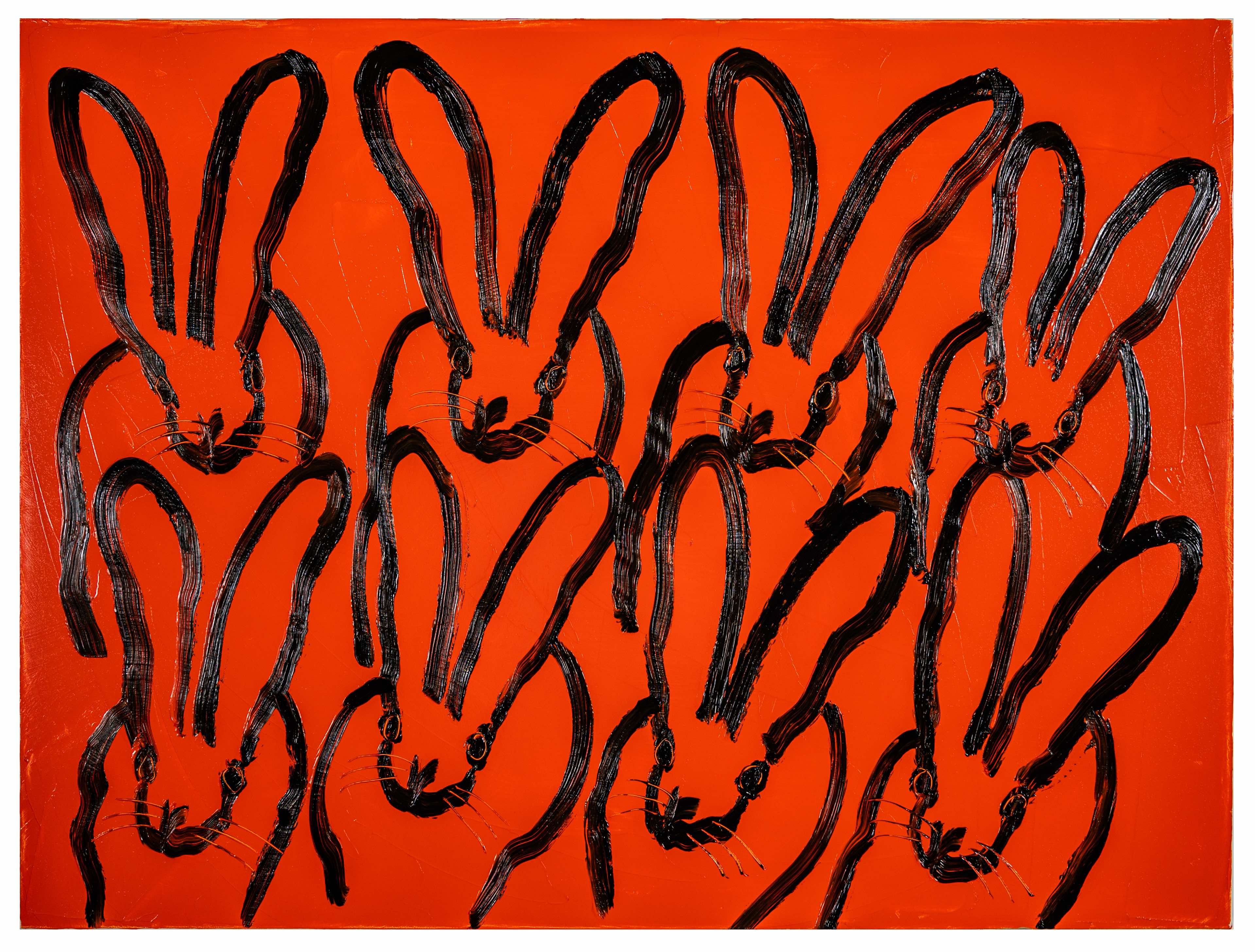
There is something disarming about a Hunt Slonem bunny.
They arrive in groups. Rows of them, loosely rendered, thick with gestural paint, each one occupying its own small space on the canvas yet entirely aware of its neighbors. And for a moment, before you step back and take in the full composition, you cannot tell whether you are looking at a painting or something more akin to an encounter.
That is precisely the point.
Where the Bunnies Began
Hunt Slonem began painting bunnies in earnest in the 1980s. He was drawn first to what he described as the purity of their form: the simplicity of an oval body, round ears, two dark eyes. The shapes were clean enough to repeat without becoming mechanical, complex enough to hold paint in interesting ways.
Slonem has owned rabbits as pets since childhood. He paints them first thing each morning as a warm-up, a ritual, a way of arriving at the day. Over decades, this daily practice has produced one of the most distinctive bodies of work in American painting.
The symbolic dimension deepened in the 1990s, when Slonem discovered he was born in the Year of the Rabbit in the Chinese zodiac. "Maybe they're sort of all self-portraits," he has said, a statement that reframes the entire series. The rows of bunnies are not just animals. They are reflections. They are the artist multiplied across canvas after canvas, each one carrying a slightly different emotional weight, a different quality of morning light.
The Meditative Logic of Repetition
To someone encountering Slonem's practice for the first time, the repetition can seem puzzling. Why return to the same subject hundreds, thousands of times? What is left to discover?
For Slonem, the answer lies in what he calls the spiritual dimension of the act itself. Painting a motif recurrently is, for him, closer to reciting a mantra than to producing a series. Each repetition accumulates. Each mark carries the energy of the one before it. What builds on canvas over time is not just image, it is, in his framing, vibration.
This places him in a meaningful tradition: artists for whom process and intention are inseparable from outcome. The bunnies are not resolved objects. They are living accumulations of gesture, attention, and time. And that quality, the sense that each painting holds the accumulated presence of a studio practice stretching across decades, is part of what makes them so consistently compelling to live with.
Scale, Format, and the Collector Experience
Slonem's bunny paintings exist in a remarkable range of scales and formats. The small panels, often 8 x 10 inches, are among the most intimate objects in contemporary American art. Designed to be grouped and hung salon-style in dense arrangements of dozens or even hundreds, they create an immersive, almost enveloping effect: a field of presence rather than a single focal point.

Slonem himself has framed these small works in 19th-century gilt frames sourced from flea markets over decades, an approach that honors the historical resonance he finds in antique objects while giving the bunnies a kind of regal, layered context. The combination of gestural contemporary painting and ornate vintage framing is, characteristically, both unexpected and entirely coherent.
Larger bunny canvases take on a different gravity. At scale, the gestural marks become structural; the repetition becomes architectural. A single large bunny painting can anchor an entire room.
Why Collectors Return
Among Slonem collectors, there is a well-documented phenomenon: people buy one, then return for another. Then another. There is something about the work: its warmth, its humor, its meditative quality, the sense that each painting holds a slightly different emotional note, that resists the idea of a single piece. The work wants to be lived with in multiples.
Interior designers have understood this for years. Slonem's bunnies translate across a wide
range of spaces: traditional rooms, contemporary interiors, coastal homes, urban apartments. His palette is genuinely flexible, warm ochres and deep golds, cool silvers and pale blue-greens, allowing for deliberate placement alongside almost any design scheme.His collaborative work with Lee Jofa and Groundworks has extended this relationship further, translating the bunny motif into textiles and wallcoverings that bring the Slonem visual world into a fully three-dimensional interior environment.
The Bunny at Auction and in the Market
Slonem's secondary market for bunny paintings has remained robust and consistent over time. Small works begin in the four-figure range and rise into the five figures depending on size, format, and period. Larger canvases and works with strong provenance can exceed that ceiling significantly.
In 2024, the Venice Biennale featured a significant Slonem installation, "The Bunny Wall" at Palazzo Bembo, affirming the continued institutional weight behind the work. His presence at the Biennale positions him not as a market phenomenon but as an artist whose contribution to contemporary painting is taken seriously at the highest levels of the field.
For collectors, this combination of market consistency, institutional recognition, and genuine emotional resonance adds up to what curators call durability: work that holds its meaning, its audience, and its ability to move people across changing cultural moments.
Frequently Asked Questions
What do Hunt Slonem's bunny paintings mean?
For Slonem, bunnies carry layers of personal and symbolic meaning, they are tied to his Chinese zodiac sign (Year of the Rabbit), his lifelong relationship with rabbits as pets, and his meditative practice of daily repetition. He has described them as potential self-portraits.
How much do Hunt Slonem bunny paintings sell for?
Small bunny panels typically begin at gallery prices of $8,000 and up. Secondary market results regularly achieve five figures, with larger works and significant canvases commanding more.
How does Hunt Slonem display his bunny paintings?
Slonem traditionally displays small bunny paintings in dense salon-style groupings, sometimes 50 to 100 works together, often set in 19th-century gilt frames he has sourced from flea markets over decades.
Are Hunt Slonem bunnies good for interior design?
Yes. Slonem's bunny paintings work across a wide range of interior styles, and the artist has collaborated with Lee Jofa and Groundworks to produce bunny-themed textiles and wallcoverings for residential and commercial use.
Where can I see Hunt Slonem bunny paintings in person?
Hunt Slonem works, including bunny paintings, are currently on view at Carousel Fine Art in Lenox Square (Atlanta), Buckhead, and Chicago. A special spotlight is featured at our Lenox Square gallery.

hunt slonem's bunnies
There is a reason the bunnies keep multiplying, on canvas, in collections, in the rooms of people who thought they were buying one and found themselves returning for more. They hold something that much contemporary art struggles to offer: presence without pretension, warmth without apology, depth arrived at through dailiness rather than spectacle.
