

There are artists whose imagery becomes instantly recognizable — not because it is 'trendy' or calculated, but because it springs from something genuinely obsessive, genuinely personal, and genuinely alive. Hunt Slonem is one of those artists.
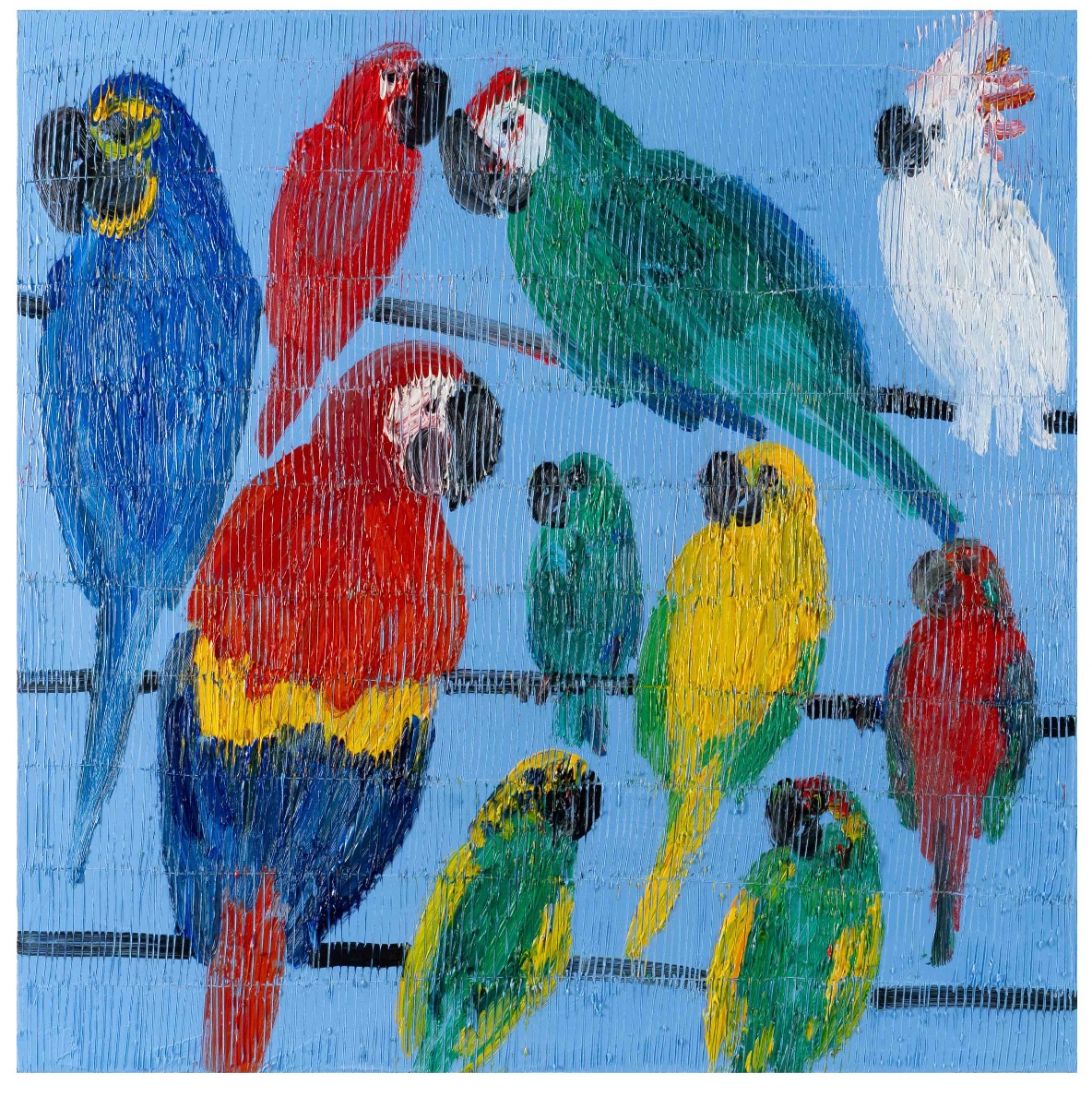
Over a career spanning more than five decades, the Maine-born, New York-based painter has devoted himself to a small, deliberate collection of subjects: bunnies, tropical birds, butterflies. Subjects that seem simple, even playful; until you stand in front of one of his canvases and feel the accumulated weight of a thousand gestural marks pushing color forward from the surface.
Slonem does not paint the natural world as documentation. He paints it as devotion.
Early Life and the Roots of a Visual Language
Born in Kittery, Maine in 1951, Hunt Slonem spent his early years moving frequently; his father was a Navy officer, through Hawaii, California, and Connecticut. Those years of displacement, punctuated by the natural beauty of coastal and tropical landscapes, left an unmistakable imprint on his visual imagination.
He studied painting and art history at Tulane University in New Orleans, a city that would later become a spiritual home of sorts. At the Skowhegan School of Painting and Sculpture in Maine, he encountered major figures of the New York art world: Louise Nevelson, Alex Katz, Alice Neel, whose fearless approaches to subject matter and mark-making planted early seeds. He moved to New York in 1973 and has been based there ever since.
The Studio, the Aviary, and the Work
To understand Slonem's paintings, you need to understand how he lives. For decades, the artist has maintained a personal aviary of 30 to 100 live tropical birds; parrots, cockatiels, finches, in the rooms where he works. These are not studied from afar. They are neighbors, companions, presences. And they find their way onto canvas with the ease of something deeply known.

His Manhattan studio has evolved over the years: from a 40,000-square-foot labyrinth on West 10th Street divided into 89 rooms, to a 15,000-square-foot former film headquarters on West 45th Street painted in the warm, layered colors of Louisiana plantation houses. Slonem has also spent significant time restoring historic antebellum properties across Louisiana, a practice that mirrors his painterly sensibility: a reverence for layered history, for surfaces that accumulate meaning over time.
Each morning, Slonem warms up by painting bunnies. It is ritual. It is meditation. And it is how a body of work with more than 350 exhibitions across five decades continues to feel urgent and alive.
Style and Influence: Neo-Expressionism with Its Own Frequency
Slonem is categorized as a Neo-Expressionist, and the label fits without confining him. Like the German Expressionists who influenced him, and like his contemporaries in the New York art world of the 1970s and 1980s, he works with emotional directness, flat pictorial space, and gestural marks that seem to leap rather than settle. Color in his paintings does not describe objects; it animates them.
What makes Slonem singular within that tradition is his commitment to repetition as a spiritual act. Dozens of bunnies arranged in loose grids. Rows of tropical birds in conversation with each other across the picture plane. Butterflies multiplied until they become something closer to rhythm than image. For Slonem, painting a motif again and again is not redundancy, it is closer to prayer.

Key Motifs
Bunnies: Introduced in the 1980s and deepened after Slonem discovered he was born in the Year of the Rabbit. Associated with luck, self-portraiture, and meditative ritual.
Birds: Drawn directly from his living aviary. Exotic species rendered with gestural confidence and vibrant, expressive color.
Butterflies: Symbols of transformation and natural exuberance, often rendered in sweeping, luminous compositions.
Museum Collections and Cultural Recognition
Slonem's work is held in the permanent collections of more than 250 museums worldwide, including the Solomon R. Guggenheim Museum, the Metropolitan Museum of Art, the Whitney Museum of American Art, the Smithsonian Institution, the Fundació Joan Miró, and the New Orleans Museum of Art.His private collectors include Yoko Ono, Jimmy Fallon, Sharon Stone, Anne Hathaway, Cameron Diaz, and Bill and Hillary Clinton — a roster that reflects the genuine breadth of his appeal across cultural, generational, and geographic lines.
Since his debut at Harold Reed Gallery in New York in 1977, Slonem has participated in more than 350 solo and group exhibitions internationally. In 2024, his installation "The Bunny Wall" appeared at Palazzo Bembo during the Venice Biennale, affirming the continued institutional weight behind his work.
What Collectors Should Know
For collectors approaching Slonem's market for the first time, his work is genuinely varied in scale and format. Small bunny panels — often 8 x 10 inches — are among his most intimate and accessible works, traditionally displayed in groupings of 50 to 100 pieces hung salon-style. His large-format bird and butterfly paintings occupy an entirely different register: commanding, chromatic, and undeniably present.

Slonem's auction record reflects sustained secondary market strength, with works regularly achieving five figures. His representation across major galleries internationally signals continued institutional and collector support.
Beyond paintings, Slonem has translated his imagery into textile collaborations with Lee Jofa and Groundworks, bringing his visual language into the world of interior design. For collectors who are also deeply engaged with interiors, the crossover is natural and well established.
Frequently Asked Questions
What is Hunt Slonem known for?
Hunt Slonem is best known for his Neo-Expressionist paintings of bunnies, tropical birds, and butterflies — rendered with gestural brushwork, vibrant color, and a spiritual commitment to repetition as artistic practice.
Where is Hunt Slonem from?
Slonem was born in Kittery, Maine in 1951. He has lived and worked in New York City since 1973, and has spent considerable time in Louisiana, where he has restored several historic plantation properties.
What museums have Hunt Slonem's work?
His paintings are in the permanent collections of more than 250 museums worldwide, including the Guggenheim, the Metropolitan Museum of Art, the Whitney Museum of American Art, and the Smithsonian Institution.
Are Hunt Slonem paintings a good investment?
Slonem's work has a sustained auction record with works regularly achieving five figures on the secondary market. Art should always be collected primarily for its resonance and meaning. For investment-specific guidance, consult a qualified art advisor.
Where can I see Hunt Slonem paintings in person?
Hunt Slonem works are currently on view at Carousel Fine Art locations in Lenox Square (Atlanta), Buckhead, and Chicago. A special spotlight installation is featured at our Lenox Square gallery.
A Final Note
More than fifty years into his career, Hunt Slonem remains one of the most genuinely distinctive voices in American contemporary art — not despite his focus on a small number of subjects, but because of it. There is something quietly radical about depth over breadth: returning to the same image until it reveals everything.
His work is currently on view at Carousel Fine Art. We invite you to experience it in person.

