

If you've been driving through Detroit this spring and found yourself doing a double-take at a billboard, you're not alone. Since April 2026, over 57 billboards picturing the unmistakable work of French pop-street artist Jisbar have take over the Detroit metro area.
The public art installation, which runs through mid-June 2026, has transformed the city's surface into what commentators are calling an open-air museum and it's generating a new buzz among art lovers, collectors, and curious commuters alike.
There's a particular kind of surprise that comes from encountering real art somewhere you didn't expect it. Not on a museum wall, not in a white-walled gallery, but on a highway overpass, or a surface road, or a digital panel you pass every morning on the way to work. It is, by any measure, one of the most ambitious public art moments this city has seen in years.
The Artist Behind the Billboards
Who is Jisbar?
Jisbar was born in 1989 in Val d'Isère, France. He lives and works between Paris and Lisbon, and his style sits at the intersection of pop art and street art, but that description undersells it.
What Jisbar actually does is build dense, layered visual worlds: hyper-saturated canvases where art history, pop culture, fashion, music, cinema, and personal memory collide and coexist. The Mona Lisa appears alongside cartoon characters. Luxury logos share space with slogans. Famous athletes are remade in the visual grammar of graffiti. Words and numbers are embedded throughout, functioning less like captions and more like codes waiting to be deciphered.
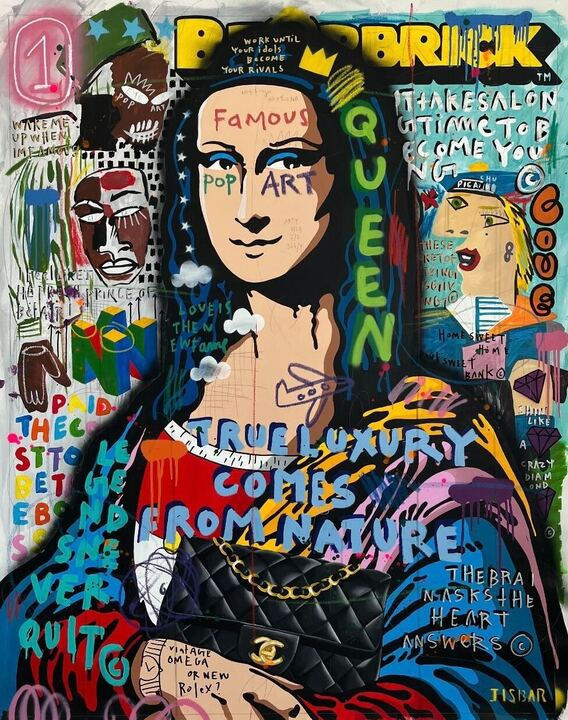
He describes individual elements within his paintings as moments of life, personal memories that take on new meaning inside the larger composition. The result is work that doesn't resolve itself on a single viewing. You keep finding things.
His technical approach matches this density: original canvases combine acrylic, spray paint, and felt pen, often worked across both hand-applied and printed surfaces.
An Open-Air Museum, by Design
The Detroit installation is not the traditional ad campaign. It was conceived and organized by Mansour Oram, COO of Farmington Hills-based International Outdoor, and a longtime Jisbar collector who first encountered the artist's work at Art Basel Miami. Oram gave Jisbar complete creative control over the selection, and the artist took the assignment seriously.
Jisbar chose works that speak directly to Detroit: pieces referencing the auto industry, American pop culture, and the films he loves. The billboards are numbered, an intentional move that invites the city to interact with the exhibition the way a collector engages with a body of work: methodically, curiously, returning to pieces that stay with you.
"It's not what they expect to see on a billboard," Jisbar said before the installation opened. "I would like to have this surprise and also be something positive."

This is consistent with a core belief that runs through his practice: art should not be confined to spaces that require permission to enter. It belongs in public life. The Detroit project is, in that sense, less a departure from gallery work and more an extension of the same impulse, the conviction that art operates best when it finds people where they already are.
Jisbar traveled to Metro Detroit in early May to sign select billboards in person and experience the city firsthand, including a Detroit Tigers game at Comerica Park. It was his first visit.
What This moment Signals
For those tracking Jisbar's trajectory, the Detroit installation is not an isolated event.
The French artist's institutional presence is substantial. His work has been exhibited at the National Museum for the History of Immigration in Paris, the Manarat Al Saadiyat in Abu Dhabi, and was part of the Louvre's La Joconde, a decade-long traveling exhibition celebrating Leonardo da Vinci.
His brand collaborations: BMW, Giorgio Armani, Patek Philippe, J.M. Weston, LG, signal the kind of cross-cultural visibility that places an artist's work in front of audiences who weren't already looking for it. So does his work alongside musicians like DJ Snake and Cardi B, and his design of custom race suits and helmets for MotoGP world champion Fabio Quartararo.
And then there is Space Lisa. In 2019, Jisbar became the first artist to send a painting into outer space, his punk reinterpretation of the Mona Lisa launched into the stratosphere at 33.4 kilometers altitude in honor of the 500th anniversary of Leonardo da Vinci's death, where it orbited the Earth for over an hour and a half. In 2021, he followed it with the first NFT ever sent to space.
The Detroit installation fits neatly into this arc. The cities that have hosted Jisbar's work: Miami, New York, Los Angeles, San Francisco, Las Vegas, London, Dubai, Milan, Venice, Taipei, are the cities that define the contemporary art market's geography. Detroit is a meaningful addition to that list.
Detroit is a driving city. Its billboards are infrastructure. To turn that infrastructure into a numbered, navigable art exhibition is to propose a different relationship between the city and its residents, one where the commute becomes a form of collecting.
Experiencing the Work
The installation runs through mid-June 2026. If you're in Metro Detroit, the billboards are worth finding.
They're numbered — Jisbar intended them to be sought out, discovered in sequence or out of it, returned to. The works selected for Detroit are specifically chosen for this audience and this place.
For those who encounter Jisbar's work for the first time through this installation and want to go deeper, Carousel Fine Art represents the artist and carries works from his catalog. We are happy to speak with collectors and those new to his practice alike.
Explore Jisbar's work at Carousel Fine Art
Contact the gallery
Carousel Fine Art is a contemporary fine art gallery with a long-standing relationship with Jisbar and a focus on artists whose work operates at the intersection of culture, history, and the present moment.
