

The Soccer Ball Is Not the Subject. It Is the Material.
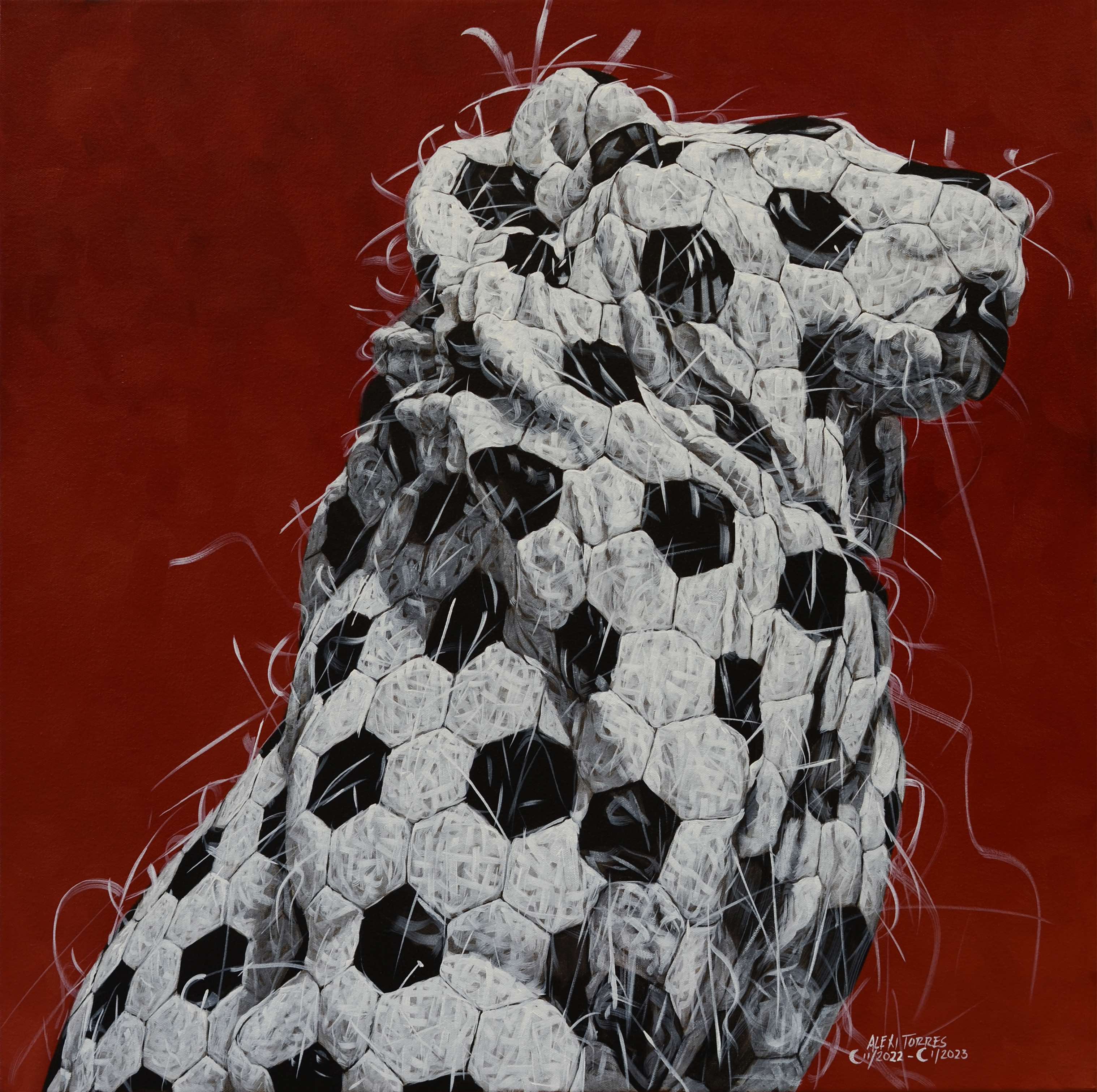
The first thing you see in an Alexi Torres canvas is the surface. It does not read as paint. It reads as cloth. Tight, interlaced, seemingly woven brushwork covers every inch of the canvas in a pattern that looks stitched, like basketwork or textile craft lifted transferred, impossibly, onto a painted ground.
In Torres's Game of Life series, the structure of a soccer ball, the hexagonal and pentagonal panels that has defined the ball since the 1970 FIFA World Cup, becomes the material for an entirely different kind of image. The panels are not simply decoration or reference. They are the material from which figures are built: a goddess's body now the pattern of a ball; classical sculpture, re-dressed in the geometry of the world's most global sport, football (AKA soccer).
This is fine art that takes soccer's most fundamental object and transforms it into the work of mythology.
A Practice Rooted in Cuba, Carried to Atlanta
Alexi Torres was born in 1976 in Bermeja, a small village in the province of Matanzas, in central Cuba. The region is defined by its agricultural land, its sugar cane fields, and a way of life organized around planting, tending, and harvest. He studied at the Escuela Provincial de Artes in Matanzas from 1989 to 1991, then at the Escuela Nacional de Artes in Havana, before immigrating to the United States in 2003. He now lives and works between Atlanta, Georgia and Zancudo, Costa Rica.
The agrarian life of his childhood did not stay in Cuba. It became the structural logic of his practice.
Torres views each painting as an act of planting and harvesting. He starts and completes every work on a waning moon, following the lunar cycles that governed the rhythms of his ancestors' fields. He builds his own stretchers. He stretches and primes each canvas himself. There is no separation, in his thinking, between the preparation of the ground and the work that grows from it.
His signature woven technique draws directly from the visual culture of that agrarian world. The basket-weaving and textile traditions of Matanzas, passed down through previous generations, surface in Torres's canvases as a formal language: flesh rendered as woven cloth, a surface that looks fabricated rather than applied. One communal object, the textile, woven into the structure of another, the ball.
Collective labor. Collective form.
His work is held in the private collections of Will Smith and Delta Airlines, and has been exhibited at the Miami International Art Fair, Scope, Art Palm Springs, the Houston Fine Art Fair, and major venues across the United States.
The Game of Life Series: A Visual Philosophy
The Game of Life series invites a look at life as a shared arena, a field where identity, community, and chance converge.
Through large-scale oils and his signature interlaced brushwork, Torres draws on the iconography of sport and symbolism to evoke how lives intersect: the geometry of a soccer ball, the rhythm of a crowd, the energy of collective striving.
The works remind us that existence isn't solitary. It is woven by connections, by movement, and by the communal pulse of shared experience. Torres's visual language stays deeply textured and rhythmic from canvas to canvas: the surface seems woven, not simply painted. In Game of Life, this technique resonates directly with the soccer ball's pattern and its motifs of unity. Just as each panel in a ball contributes to its global form, each individual soul contributes to the greater whole.
The interplay of form and pattern becomes a metaphor for togetherness, for how separate lives merge, influence one another, and create something larger than the sum of their parts.
Ultimately, Game of Life is a meditation on connection, shared destiny, and the human capacity for solidarity. In a world often focused on separation and division, the series asks viewers to remember that life is collective: that victories, losses, and hopes all ride across a common field. There is an invitation in these canvases to trust intuition, to sense the invisible bonds linking one person to the next, and to find a measure of peace in the knowledge that we are, always, part of something greater.
The Works on View at Carousel Fine Art
Goddess of Love (2022, 90 x 54 in)
The series opens here: a divine figure built entirely from the hexagonal and pentagonal panels of a soccer ball rendered in Torres's woven oil technique. At 90 by 54 inches, the scale commands.

The Venus de Milo has stood in the Louvre since 1820, an armless marble fragment that became one of the most recognized images of beauty in Western art. Most people who recognize her have never set foot in Paris. They know the silhouette from textbooks, postcards, parody. Torres takes that fragment, a reference once reserved for art history and rebuilds her in the same interlaced thread he gives a soccer ball. The goddess of love becomes legible to anyone who has ever had a ball at their feet. That is the trade Torres makes across this entire series: he takes what was specific and exclusive, a sculpture behind glass in a Paris museum, and renders it in the language nearly everyone on earth already speaks.
Game of Life (2022, 96 x 72 in)
The largest canvas on view and the one that states Torres's thesis most directly. A rearing horse, a figure drawn from the tradition of equestrian heroism running from Greek friezes to Baroque painting, built from the woven soccer ball panels that define the series.
The rearing horse signals power, urgency, and the moment before decisive action. In Torres's hands, it signals something more specific: the way sports, like mythic struggles, carry within them the full weight of human effort and collective longing. Game of Life is a meditation on connection, shared destiny, and the human capacity for solidarity.

Invincible Man, Angel of Joy, Born to Win (2023-2024, 80 x 64 in each)
Three works, three moments.
Invincible Man references Auguste Rodin's The Thinker, one of the most recognized sculptures in the Western canon: a seated figure, weight on a fist, locked in contemplation. Torres takes that pose and rebuilds it entirely from the woven panels of a soccer ball. The bronze original sits in gardens and museum courtyards, a fixture of art history surveys. Torres's version needs no survey course. A soccer ball, a thinking man, a title that promises strength instead of doubt.
Angel of Joy (2023) Winged Victory of Samothrace
Nike of Samothrace lost her head and arms centuries ago and gained something else: status as one of the most photographed sculptures alive, perched at the top of the Louvre's Daru staircase, wings spread mid flight. Torres calls his version Angel of Joy, a title that strips away the Greek name and the museum context and keeps only the feeling.

Born to Win and The Three Graces — Canova's Three Graces
Aglaea, Euphrosyne, and Thalia: goddesses of charm, mirth, and beauty, subjects of canonical Western sculpture from antiquity through Canova. Torres places them inside the geometry of the world's most global sport.

A second-century Roman marble version of the Three Graces, restored by Nicolas Cordier in 1609, has stood in the Louvre for centuries. Torres returns to that image twice, and the two paintings take it in different directions. The Three Graces stays close to the source, the embrace, the interlocking forms. Born to Win pulls the same three figures toward triumph, toward the language of competition that runs through the rest of the series. One painting honors the sculpture's intimacy. The other turns it into a podium.

The precision of a well-struck ball, the flow of a forward run, the geometry of a perfectly executed set piece: these are expressions of the same human impulse that produced the classical tradition. By dressing the Three Graces in soccer ball panels, Torres refuses the hierarchy that places fine art above sport. Both, he argues, are forms of collective human beauty.
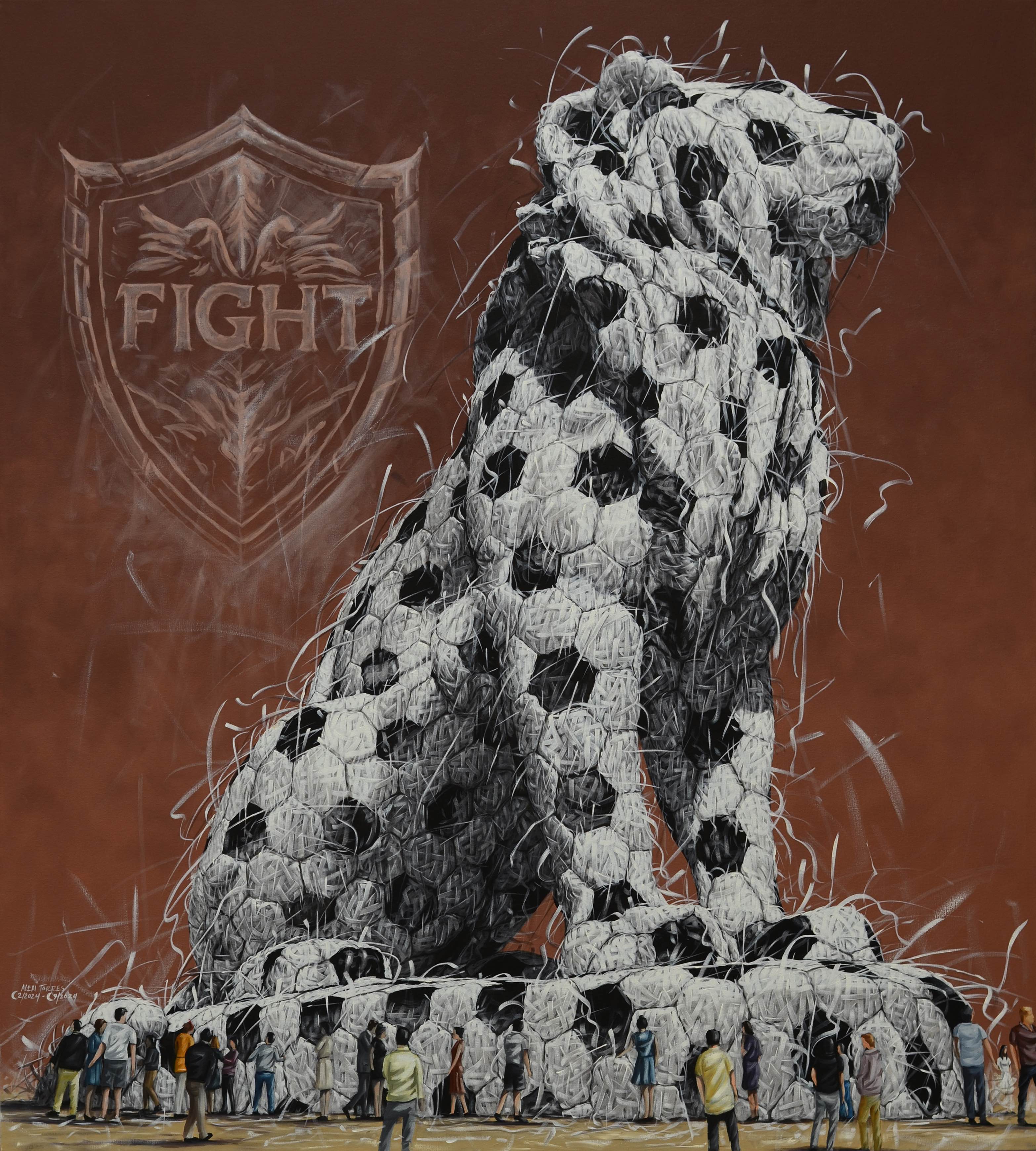
Fight and The King — lions in classical and Renaissance symbolism
Lions have stood for strength and sovereignty since antiquity, carved into thrones, cast in bronze outside Florentine palaces. The Medici lions outside the Palazzo Vecchio are one well-known example of that tradition, not the only one Torres draws from. Fight and The King both reach for that long lineage of the lion as dominance and nerve, then hand it to a soccer ball. The crown changes hands. The throne becomes a pitch.
The 2026 World Cup and The Beautiful Game
The 2026 FIFA World Cup has brought Atlanta into the center of the most widely watched sporting event on the planet.
Eight large-format canvases, all oil on canvas, all built from the woven geometry of the soccer ball, are on view in Buckhead through July 31. For collectors entering the World Cup period looking for works that carry weight beyond the tournament, the Game of Life series offers exactly that: a body of work with deep roots in Cuban-American artistic tradition and a philosophical premise as universal as the technique it is expressed through.
Life is collective. Torres's practice has always known this. The World Cup just makes it harder to argue otherwise.
See the Works
Exhibition: The Beautiful Game: World Cup Art Exhibition 2026 Venue: Carousel Fine Art, Buckhead, Atlanta, GA Dates: Now on view through July 31, 2026 Inquiries: hello@carouselartgroup.com
All eight Game of Life works are available for acquisition. Contact the gallery directly for pricing and availability.
Frequently Asked Questions
Who is Alexi Torres? Alexi Torres (b. 1976, Bermeja, Matanzas, Cuba) is a contemporary painter who lives and works in Atlanta, Georgia and Zancudo, Costa Rica. He studied at the Escuela Nacional de Artes in Havana before immigrating to the United States in 2003. He is among the most significant Cuban-American painters working today. His work is held in the collections of Will Smith and Delta Airlines.
What is Alexi Torres's Game of Life series about? The Game of Life series constructs mythological figures from the geometric panels of a soccer ball, rendered in Torres's signature woven oil technique. The series meditates on collective experience, the idea that each soul, like each panel in a ball, contributes to a greater whole. Works in the series include Goddess of Love, Game of Life, Invincible Man, Angel of Joy, Born to Win, The Three Graces, The King, and Fight.
What is Alexi Torres's painting technique? Torres's paintings are built from a tight, interlaced brushwork that makes each canvas appear woven rather than painted. The technique is drawn from the basket-weaving and textile traditions of Matanzas, Cuba, where he grew up. He builds his own stretchers, primes his own canvases, and begins and completes each work on a waning moon.
Where can I see Alexi Torres's paintings in Atlanta? Eight works from the Game of Life series are on view at Carousel Fine Art's Buckhead gallery in Atlanta as part of The Beautiful Game exhibition, through July 31, 2026.
